Death Major Arcana XIII · tarot card meaning
- Sign
- Scorpio
- Hebrew letter
- Nun
- Yes or no
- Yes
Death upright
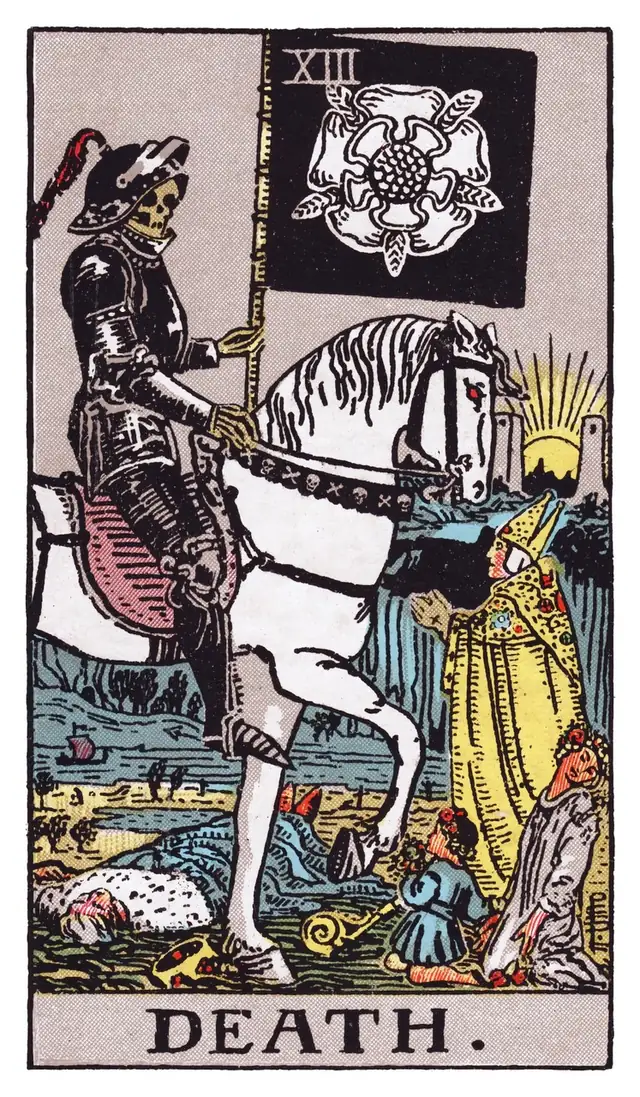
Death suggests an ending that has already happened. Something may finish cleanly, or an old identity may stop being usable. Look behind the rider. The rising sun shows this ending already opening onto another beginning.
Yes or no: Yes, once the old part ends. Death answers through the clean close of one stage.
Death reversed
Reversed, Death is an ending you are refusing — something kept alive by habit. Contact held after the reason went, or grief postponed by staying busy. Tradition reads the reversal as the same ending, delayed.
Yes or no: Not yet. Reversed, something is held onto past its time, and the ending stalls.
The card at a glance
- Attribution
- System
- First printed
- Themes
- ending, change, beginning
What is shown
An armoured skeleton rides a white horse. Its black banner carries a white five-petalled rose. A crowned ruler lies beneath the horse. A bishop faces the rider with folded hands. A woman turns away. A child looks directly forward with flowers in hand. Between two distant towers, the sun touches the horizon.
- Number
- XIII
- Yes or no
- No
Death upright
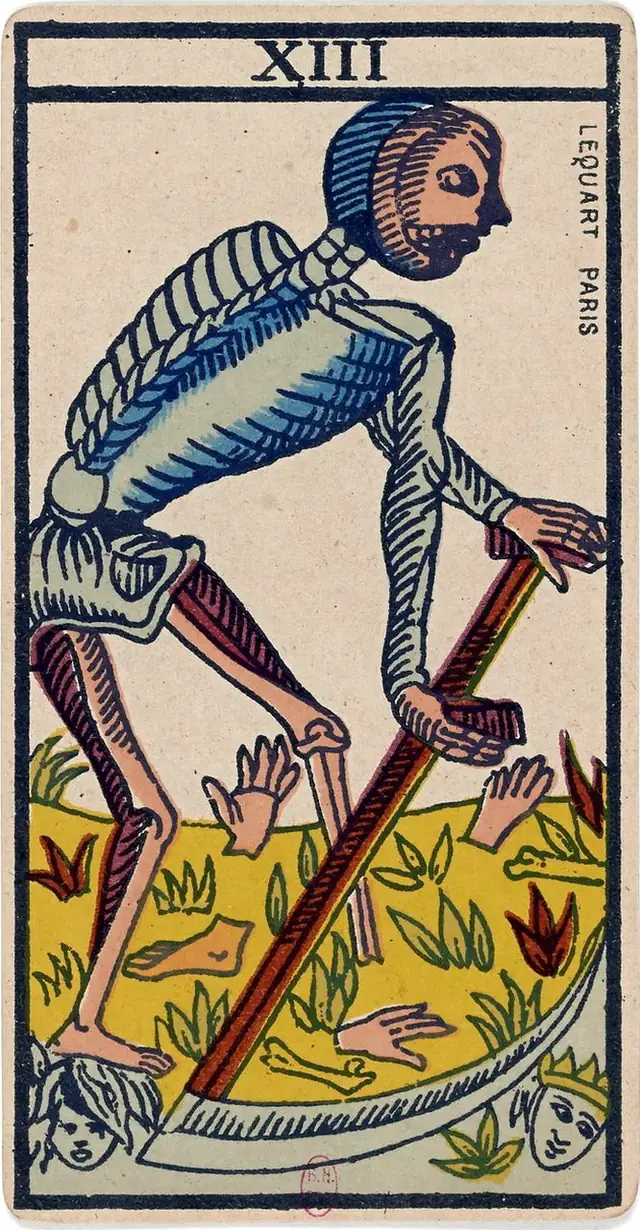
The untitled thirteenth card shows a skeleton clearing a field where new forms still rise. It marks an ending already underway.
Yes or no: No. La Mort closes the present form so something else can begin.
Death reversed
Reversed, the clearing stalls because change or loss remains difficult to face. What is over has not been released.
Yes or no: Not yet. Reversed, the necessary ending is still being resisted.
La Mort is read in its Marseille title, image, and position; its RWS link is a structural cross-reference, not permission to replace the card's identity.
The card at a glance
- Printed title
- None
- Catalogue title
- La Mort
- Printed number
- XIII
- Edition
- Themes
- ending, change, beginning
- Deck
- Tarot de Marseille: Death (La Mort)
What is shown
A skeleton strides across dark soil while sweeping a long scythe. Severed hands, feet, bones, and two heads lie among small plants. One head wears a crown. XIII appears above, but the title panel is blank.
- Attribution
- Catone (13)
- Yes or no
- No
Death upright
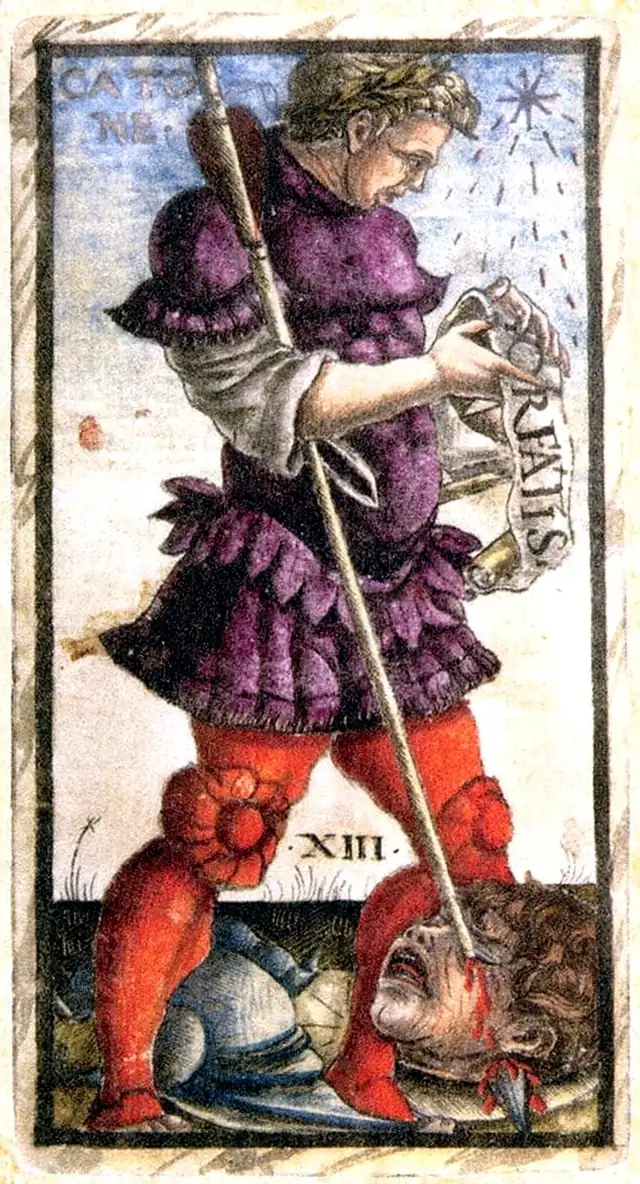
Catone steps beside a severed head while carrying a staff and an inscribed shield. The scene places principle and movement beside irreversible consequence.
Yes or no: No. Catone shows a hard boundary shaped by an irreversible consequence.
Death reversed
Reversed, consequence is denied or suffering becomes proof of virtue. A hard principle may continue after it stops protecting dignity.
Yes or no: No. Reversed, rigidity and unexamined suffering still control the answer.
Catone is read within Sola Busca's own trump order, not as a stand-in for an RWS major.
The card at a glance
- Attribution
- Catone (13)
- Workshop
- First documented
- c. 1491
- Brera programme
- Themes
- ending, change, beginning
- Deck
- Sola Busca: Catone (13)
What is shown
Catone steps over or beside a severed bearded head. He carries a long staff and a pale object in his forward hand. An inscribed shield rises along the right edge.
Questions
What does Death mean?
An ending that changes the shape of what remains. Death suggests an ending that has already happened.
What does Death mean reversed?
Reversed, Death is an ending you are refusing — something kept alive by habit.
Is Death a yes or no card?
Yes upright, not yet reversed. Once the old part ends.
What is shown on Death?
An armoured skeleton rides a white horse.