The Emperor Major Arcana IV · tarot card meaning
- Sign
- Aries
- Hebrew letter
- Heh
- Yes or no
- Yes
The Emperor upright
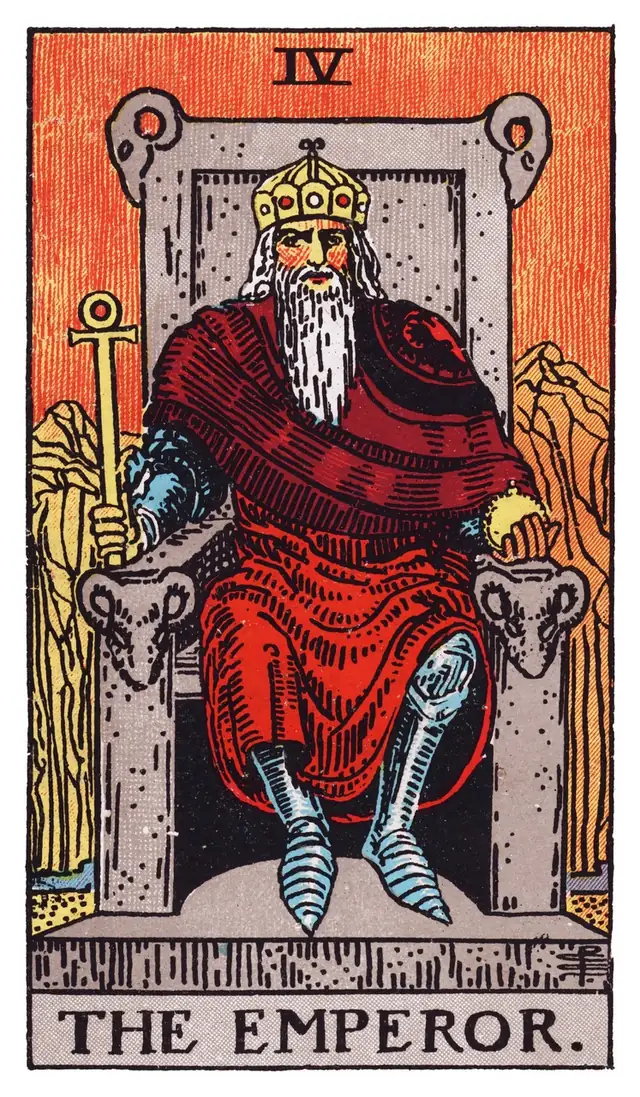
The Emperor is structure that keeps you safe — clear rules and a kept promise, someone steady enough to build on. Look at the throne: it is stone, and there is armour under the robe.
Yes or no: Yes, if you hold the structure. The Emperor answers through order rather than luck.
The Emperor reversed
Reversed, the Emperor points to order turned into command — rules made by one and kept by both. Warmth made conditional, or distance mistaken for strength. The armour is still there. The protection is not.
Yes or no: Not yet. Support may exist, but obstruction or immaturity weakens the structure behind it.
The card at a glance
- Attribution
- System
- First printed
- Themes
- power, tradition, balance
What is shown
A white-bearded ruler sits on a square stone throne. Four carved rams' heads face outward from it. Armour shows beneath his red robe. He holds an and a small golden globe. Bare red mountains fill the background. A narrow stream is the only soft line in the landscape.
- Number
- IV
- Yes or no
- Yes
The Emperor upright
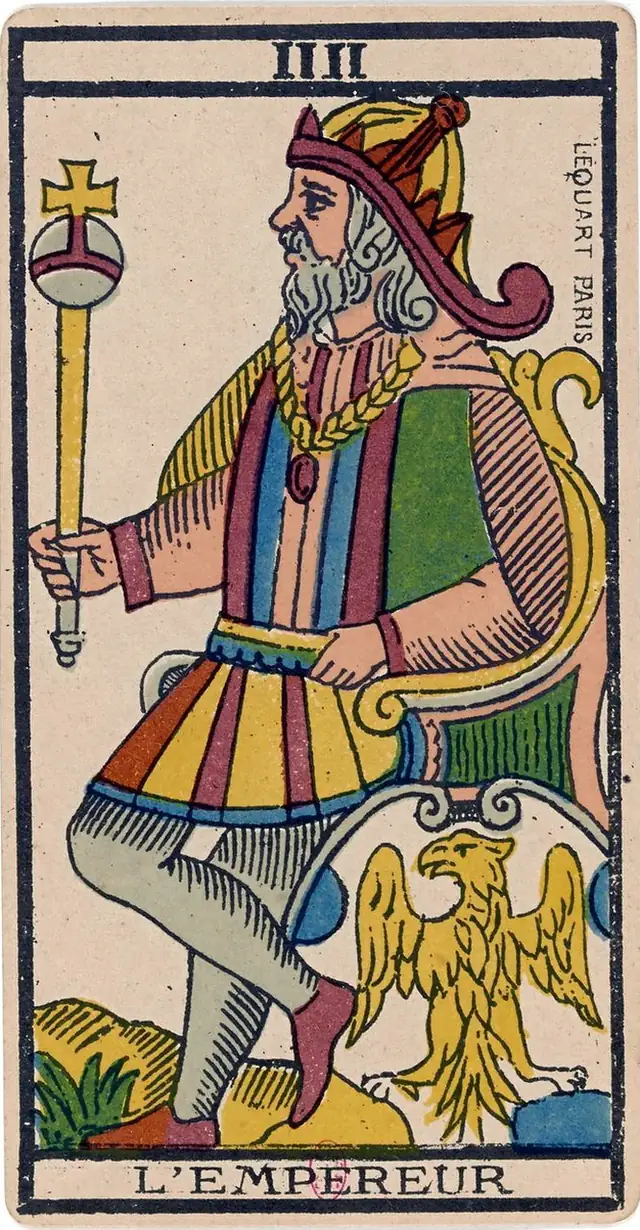
L'Empereur sits in profile, holding his sceptre while his crossed legs echo the figure four. He represents authority, order, stability, and practical control.
Yes or no: Yes, if the responsibility is carried with the authority.
The Emperor reversed
Reversed, it can show rigidity, or authority claimed without carrying what it costs. It asks who is really holding the seat.
Yes or no: No, if force or control is replacing responsibility.
L'Empereur is read in its Marseille title, image, and position; its RWS link is a structural cross-reference, not permission to replace the card's identity.
The card at a glance
- Printed title
- L'EMPEREUR
- Printed number
- IIII
- Pattern
- Edition
- Themes
- power, tradition, balance
- Deck
- Tarot de Marseille: The Emperor (L'Empereur)
What is shown
A bearded emperor sits sideways with one leg crossed over the other. He holds a sceptre topped by an orb and cross. A large eagle shield rests below his seat. Crown, chain, armour, and striped tunic crowd the upper body. The card prints IIII.
- Attribution
- Mario (4)
- Yes or no
- Yes
The Emperor upright
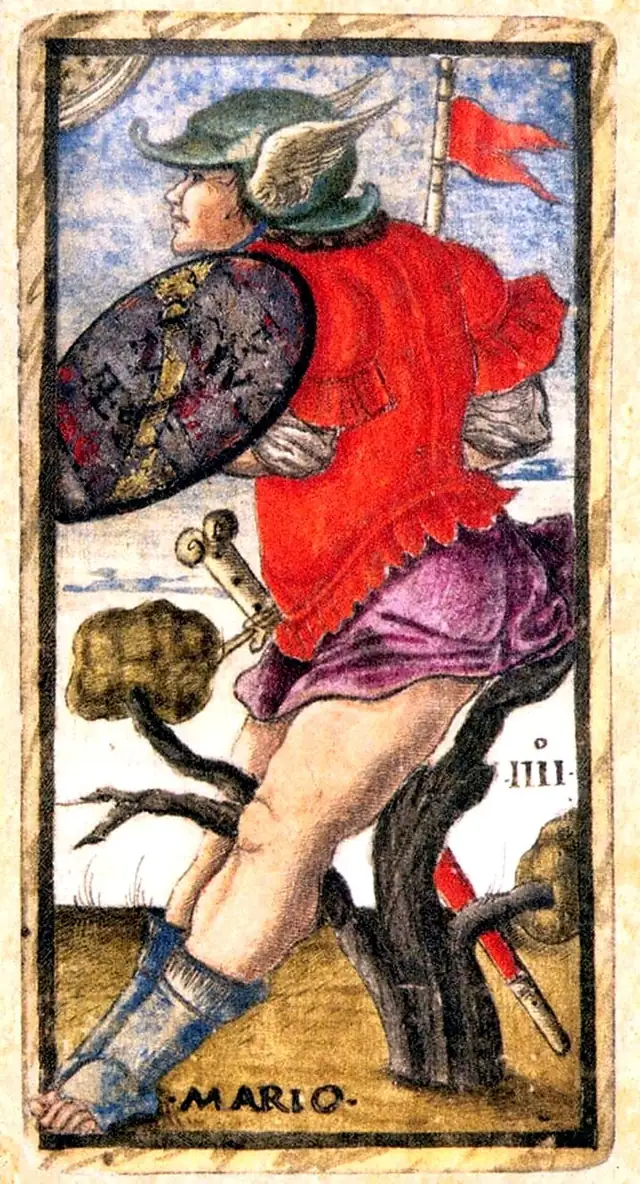
Mario advances in armor with shield, sword, and standard. The military scene supports disciplined public action and duty larger than private preference.
Yes or no: Yes. Mario can advance when the duty remains worth carrying.
The Emperor reversed
Reversed, duty hardens into obedience or force replaces judgment. The public role begins to consume the person carrying it.
Yes or no: No. Reversed, obedience has replaced independent judgment.
Mario is read within Sola Busca's own trump order, not as a stand-in for an RWS major.
The card at a glance
- Attribution
- Mario (4)
- Workshop
- First documented
- c. 1491
- Themes
- power, tradition, balance
- Deck
- Sola Busca: Mario (4)
What is shown
Mario moves right in bright red and violet armour, carrying a decorated shield and a red flag. A sword hangs at his side and a dark, pollarded tree rises behind him.
Questions
What does The Emperor mean?
Structure, authority, and the rules in place. The Emperor is structure that keeps you safe — clear rules and a kept promise, someone steady enough to build on.
What does The Emperor mean reversed?
Reversed, the Emperor points to order turned into command — rules made by one and kept by both.
Is The Emperor a yes or no card?
Yes upright, not yet reversed. If you hold the structure.
What is shown on The Emperor?
A white-bearded ruler sits on a square stone throne.