
The Hierophant Major Arcana V · tarot card meaning
- Sign
- Taurus
- Hebrew letter
- Vav
- Yes or no
- Yes
The Hierophant upright
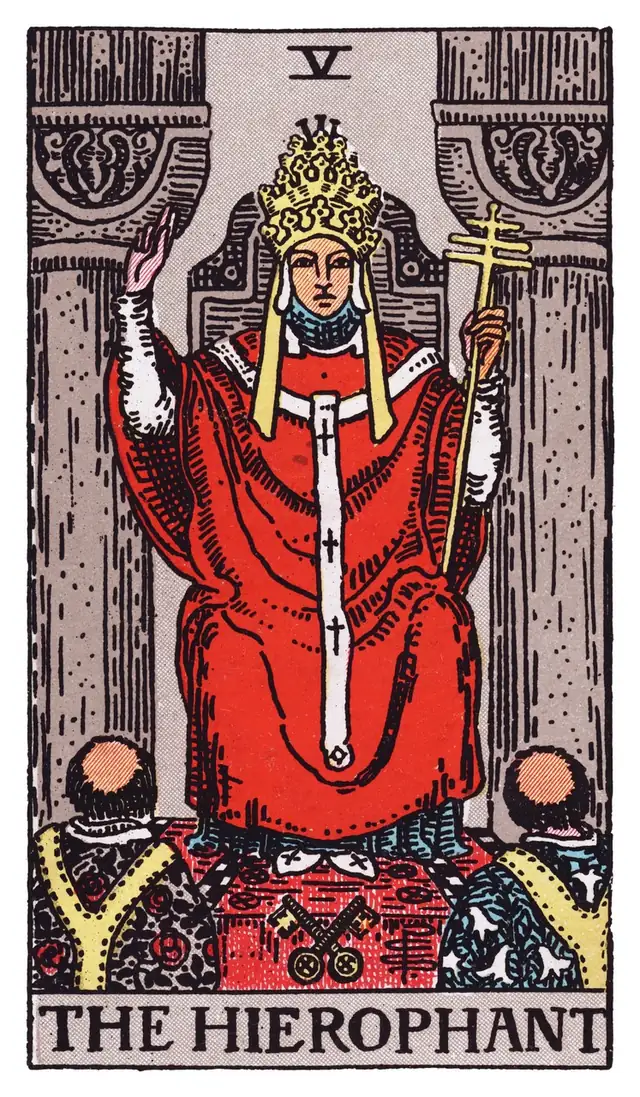
The Hierophant reads as learning through a form somebody else built: a teacher, a tradition, a rite you join. Look at what is at his feet: two crossed keys. The card is about who is allowed to hand them over.
Yes or no: Yes, through the accepted path. The Hierophant answers by way of what already works.
The Hierophant reversed
Reversed, the Hierophant points to society, agreement, and shared understanding weakened by over-accommodation. Goodwill is present, but conviction may bend too easily. The keys remain a sign of authority, not proof that convention has been rejected.
Yes or no: Yes, but weakly. Agreement is possible, though over-accommodation may make it hard to sustain.
The card at a glance
- Attribution
- System
- First printed
- Themes
- tradition, connection, growth
What is shown
A religious ruler sits between two grey pillars. He wears a triple crown and raises two fingers in blessing. His other hand holds a staff with three crossbars. Two crossed keys lie below him. Two tonsured attendants kneel with their backs toward us. Roses cover one robe, while lilies cover the other.
- Number
- V
- Yes or no
- Yes
The Hierophant upright
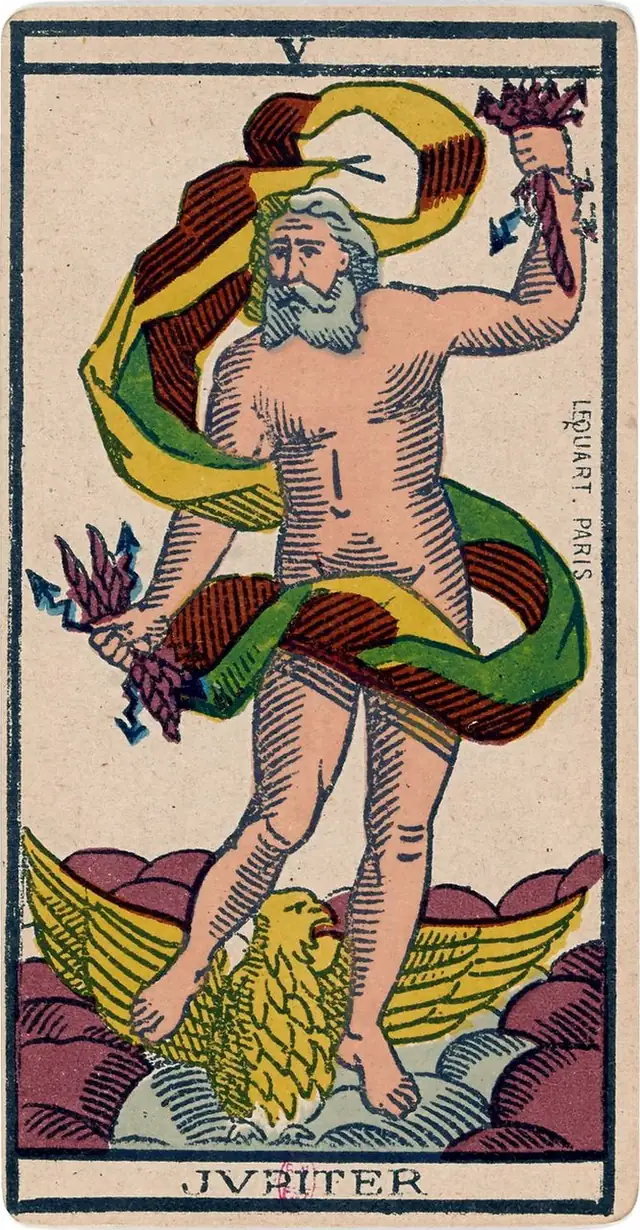
Jupiter stands on an eagle with lightning held in both hands. This Besancon image links authority with force, judgment, and the power to appoint or punish.
Yes or no: Yes, if the authority is legitimate and willing to carry the consequence.
The Hierophant reversed
Reversed, authority becomes arbitrary, or force is treated as proof of being right. The question is whether power still accepts responsibility for its effects.
Yes or no: No. Power without fairness makes the answer unstable.
Jupiter is trump V in Lequart's Tarot de Besancon, a Marseille-pattern variant. The RWS link marks sequence only. This image is not Le Pape.
The card at a glance
- Printed title
- JUPITER
- Structural slot
- Trump V · Le Pape in Marseille packs
- Pattern
- Edition
- Themes
- tradition, connection, growth
- Deck
- Tarot de Marseille: Jupiter
What is shown
A bearded nude god stands among clouds with a long striped mantle circling his body. Each hand grips a bundle of flaming thunderbolts. A great eagle spreads its wings below his feet. The card prints JUPITER at the bottom and V above.
- Attribution
- Catulo (5)
- Yes or no
- Yes
The Hierophant upright
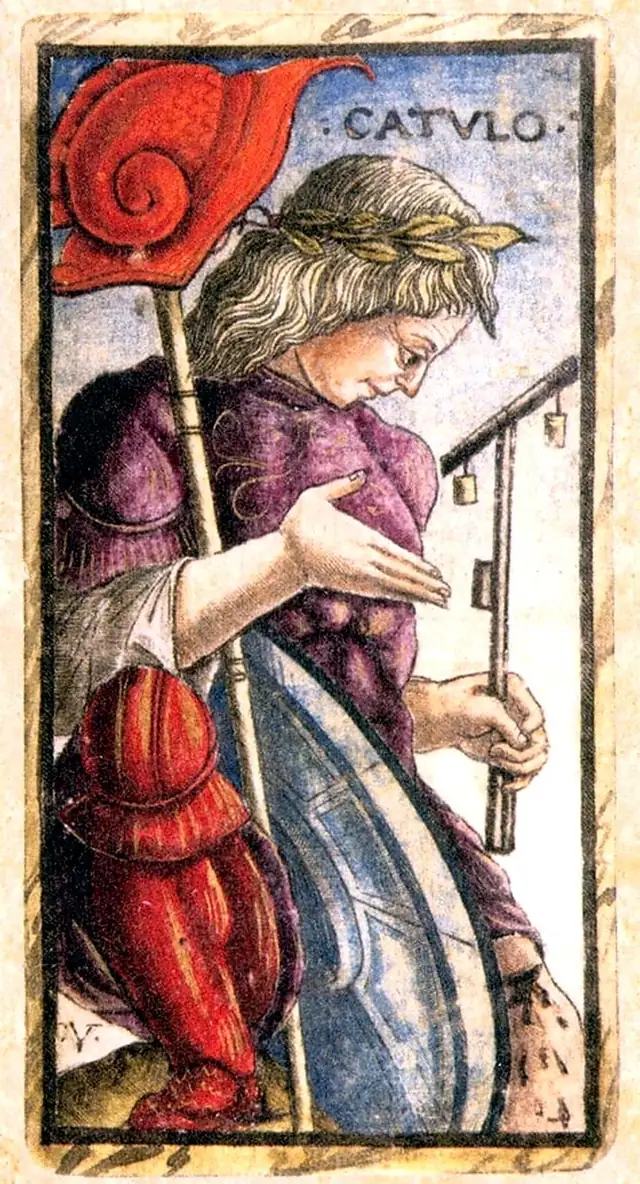
Catulo advances with a tall shield before him and a long weapon held close. The scene supports guarded movement, caution, and defended intent.
Yes or no: Yes. Catulo supports cautious movement with necessary protection.
The Hierophant reversed
Reversed, defense blocks the view or caution prevents meaningful advance. Protection becomes an obstacle carried into every encounter.
Yes or no: No. Reversed, the defense now blocks the way forward.
The app treats Catulo as its own historical figure — part of the Sola Busca sequence, not an RWS equivalent.
The card at a glance
- Attribution
- Catulo (5)
- Workshop
- First documented
- c. 1491
- Themes
- tradition, connection, growth
- Deck
- Sola Busca: Catulo (5)
What is shown
A youthful Catulo advances left, gripping a long narrow staff or spear. A tall blue shield curves up before him. His red cap and divided red clothing stand sharply against the pale ground.
Questions
What does The Hierophant mean?
A shared system of belief, learning, or belonging. The Hierophant reads as learning through a form somebody else built: a teacher, a tradition, a rite you join.
What does The Hierophant mean reversed?
Reversed, the Hierophant points to society, agreement, and shared understanding weakened by over-accommodation.
Is The Hierophant a yes or no card?
Yes upright, yes reversed. Through the accepted path.
What is shown on The Hierophant?
A religious ruler sits between two grey pillars.