Can you read tarot for yourself?
Reading tarot · 2 min read · updated
Yes. Reading for yourself is the most common way tarot is used today, and there is no rule against it. Its real difficulties are practical: we read what we hope to see, and we keep asking the same question. A clear question, a fixed spread and a written record solve most of that.
- Allowed
- Yes, no rule forbids it
- Main risk
- Reading what you want to see
- Second risk
- Asking the same question again and again
- Helps
- Open questions, fixed spreads, a journal
Is it allowed?
There is no tarot authority and no rule against self-reading. The idea that you "should not read for yourself" is a modern belief, not a rule. Even Waite's guide of 1911, written for a reader consulting the cards on behalf of a , notes that a reader may be their own querent.[1] Today most people who read tarot read for themselves: a card in the morning, a spread for a question, a journal of their readings.
The two real difficulties
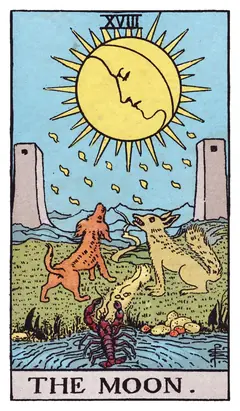
Bias. You know what you want the answer to be, and you will find it. The Moon can look like a warning or like romance, depending on your mood.
Repetition. When the answer is not the one you wanted, it is tempting to shuffle and ask again. Three readings on one question usually produce three different answers and more confusion.
How to read for yourself honestly
- Ask open questions about yourself. "What am I not seeing about this?" is hard to bend. "Does he love me?" is easy to bend. See How to ask tarot a question.
- Decide the spread before you shuffle. Write the positions down, so you cannot reinterpret them after seeing the cards.
- Describe before you interpret. Say what is literally in each picture before you decide what it means for you.
- Write it down. A written reading cannot quietly change. See How to keep a tarot journal.
- One reading per question. If the answer is unclear, wait a day, or draw one , then stop.
- Notice your reaction. Relief or disappointment when a card appears is information too. Note it.
When another reader helps
A friend or a professional reader brings a view that is not yours. That is useful when you are too close to a question, for example in a breakup or a big decision. Reading together, each person drawing and reading in turn, combines the two.
For health, money or legal matters, read the cards alongside the advice of someone who knows the facts: a doctor, a lawyer, an accountant.