Pamela Colman Smith
People · 3 min read · updated
Pamela Colman Smith (1878–1951) was the British-American artist who designed and drew all 78 cards of the Rider–Waite–Smith tarot in 1909, the most widely used tarot deck in the world. She was paid a flat fee, her name was left off the box for most of the 20th century, and she died poor in Cornwall.
- Born
- 16 February 1878, London
- Died
- 18 September 1951, Bude, Cornwall
- Known for
- Rider–Waite–Smith tarot, 1909
- Trained
- Pratt Institute, Brooklyn, from 1893
- Also
- Illustrator, stage designer, storyteller, publisher
- Signature
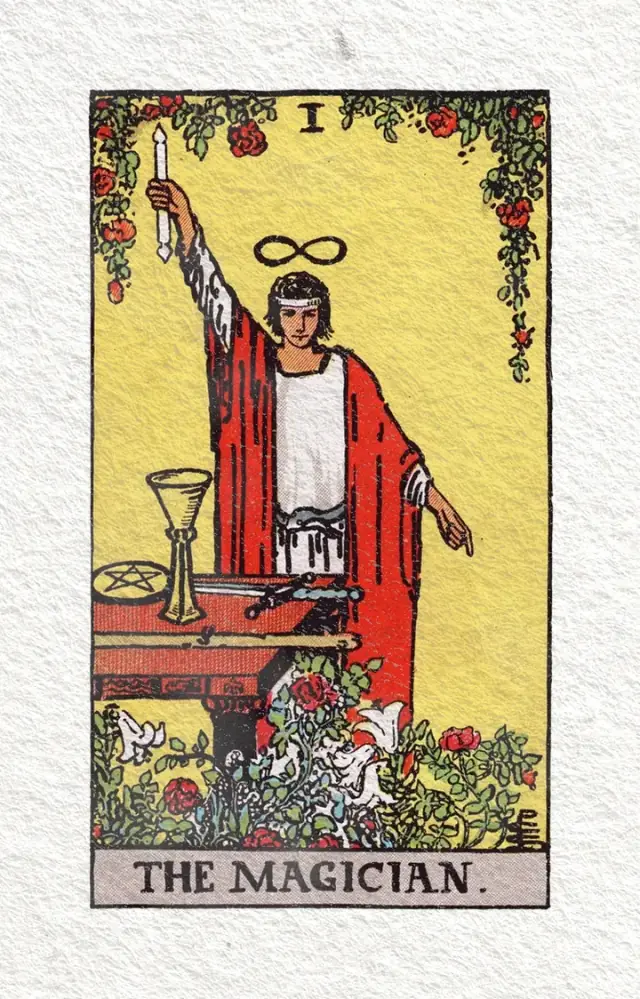
- A monogram of her initials, on most of the cards
Early life
Pamela Colman Smith was born in Pimlico, London, on 16 February 1878, the only child of American parents. Her childhood moved between England, the United States and Jamaica, where her father worked for a railway company from about 1889.[1] Jamaican folk tales stayed with her: her first book, Annancy Stories (1899), retold the Anansi stories she had heard there.[1]
At fifteen she enrolled at the Pratt Institute in Brooklyn, where she studied with the painter Arthur Wesley Dow. She left without a degree and began working as an illustrator in New York.[1]
Theatre, books and London
Through the actor Ellen Terry she began working with Terry and Henry Irving's Lyceum Theatre company, and in 1900 she moved to London, where she designed costumes and stage sets and became part of the city's artistic circles. Friends called her Pixie.[1] She told stories on stage, illustrated broadsides for W. B. Yeats's Cuala Press and Bram Stoker's The Lair of the White Worm (1911), and from 1903 published her own small magazine, The Green Sheaf.
Through Yeats she joined the Hermetic Order of the Golden Dawn in 1901, the magical society where she later met Arthur Edward Waite.[1]
In January 1907 the photographer Alfred Stieglitz showed her watercolours at his Little Galleries of the Photo-Secession in New York, the gallery later known as 291. It was the first exhibition there that was not photography, and it was one of the gallery's most visited shows.[2]
The tarot commission
In 1909 Waite asked Smith to illustrate a new tarot deck. He supplied the order of the cards and the symbolism of the ; the rest was hers. Smith drew all 78 designs in a few months, and the deck was published by William Rider & Son in London in December 1909.[3]
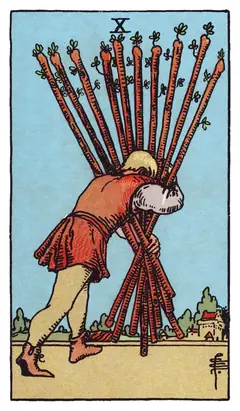
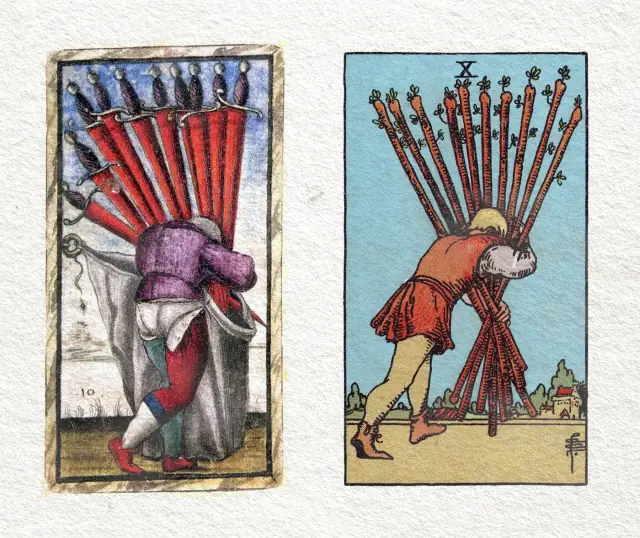
Her decisive change was in the . In most earlier decks a card like the Seven of Cups showed only seven cups. Smith turned the numbered cards into scenes with people: a man bent under a bundle of staves in the Ten of Wands, a cloaked figure mourning spilled cups in the Five of Cups, a traveller walking away in the Eight of Cups. That is why her cards can be read without memorising a list of meanings, and why almost every modern deck copies the idea.[3]
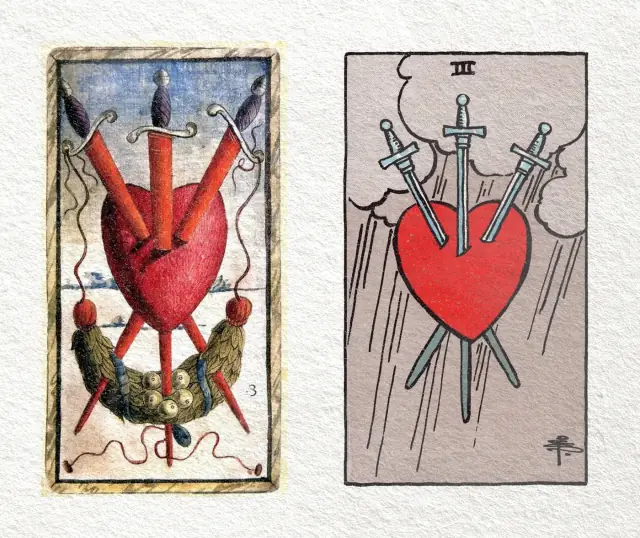
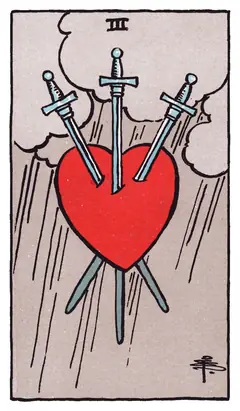
She worked from real sources. Photographs of the Sola Busca tarot, the only early deck with illustrated numbered cards, were given to the British Museum in 1907, and several of her cards follow its compositions, the Ten of Wands and the Three of Swords among them.[4] More in the Sola Busca article.
When she finished, she wrote to Stieglitz that she had "just finished a big job for very little cash". She was paid a flat fee and received no royalties from a deck that has since sold in the tens of millions.[1]
Later life
In 1911 Smith became a Roman Catholic. She later moved to the Lizard peninsula in Cornwall and then to Bude, on the county's north coast, where she ran a house that offered lodging to Catholic priests.[5] Her art was out of fashion and her money ran out. She died in Bude on 18 September 1951. Her belongings were sold to pay her debts, and the place of her grave is not known.[1]
Recognition
For most of the 20th century the deck was sold as "the Rider tarot" or "the Rider–Waite tarot", after its publisher and its author. Smith's name was not on the box. From the 1990s historians and readers began to call it the Rider–Waite–Smith or Smith–Waite tarot.[6] A full biography with her letters and artwork appeared in 2018.[1]
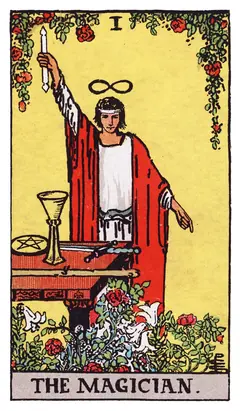
Her monogram, a small knot of the letters P, C and S, is still in the corner of most of her cards; look for it at the bottom of The Magician. Pulp uses her original 1909 drawings for the Rider–Waite–Smith deck. Smith died more than seventy years ago, so her artwork is in the public domain.