The Golden Dawn
People · 4 min read · updated
The Hermetic Order of the Golden Dawn was a British magical society, founded in London in 1888, whose tarot teaching shaped almost every modern deck. It tied each card to a Hebrew letter, a planet, a sign of the zodiac or an element, swapped Strength and Justice, and taught tarot as a map of its whole system. Its members included Arthur Edward Waite, Pamela Colman Smith and Aleister Crowley, who made the two most influential tarots of the 20th century.
- Founded
- London, 1888 (Isis-Urania temple)
- Founders
- William Wynn Westcott, S. L. MacGregor Mathers, William Robert Woodman
- Split
- 1900–1903, into rival orders
- Tarot text
- Tarot members
- Waite, Smith, Crowley
- Decks from its system
- Rider–Waite–Smith, Thoth
- Made public
- Israel Regardie, 1937–1940
What was the Golden Dawn?
The Golden Dawn was a private society for the study and practice of ceremonial magic. Three Freemasons founded it: William Wynn Westcott, a London coroner, Samuel Liddell MacGregor Mathers and William Robert Woodman. Its first temple, Isis-Urania, opened in London in 1888. Its authority rested on a set of cipher manuscripts Westcott claimed to have decoded and on letters from a German adept, Anna Sprengel, who was almost certainly invented.[1]
Members passed through grades named after the Kabbalah's , and from 1892 the most advanced entered a Second Order, where the actual magic was taught. Unusually for the time, women joined on equal terms with men. By the mid-1890s there were over a hundred members, among them the poet W. B. Yeats, the actress Florence Farr, the writer Arthur Machen, the artist Moina Mathers, and the three who matter most to tarot: Arthur Edward Waite, Pamela Colman Smith and Aleister Crowley.[1]
What did the Golden Dawn teach about tarot?
Tarot was a core subject. Mathers wrote the order's main text on the cards, known as , and every adept copied out a deck by hand from designs based on his.[2] The teaching took the French occultists' idea that tarot was a book of hidden wisdom and fitted every card into a single system of .
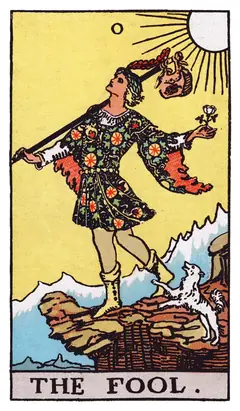
- The 22 trumps each took a letter of the Hebrew alphabet, starting with the Fool on the first letter, Aleph, and a sign, planet or element. They were also the 22 paths between the spheres of the Tree of Life. See .
- The 36 numbered cards from Two to Ten each took one , a ten-degree slice of the zodiac, with a planet and a title, such as Lord of Peace Restored for the Two of Swords.
- The four aces were the roots of the four .
- The courts were renamed King, Queen, Prince and Princess and given elemental pairs, fire of water, air of earth and so on.
Older occult tarot, from Lévi in Paris, had already linked trumps to Hebrew letters, but in a different order, with the Fool near the end. The Golden Dawn's order won in the English-speaking world, and most tarot books still print it. See Tarot and astrology and Tarot and the Kabbalah.
Why did the Golden Dawn swap Strength and Justice?
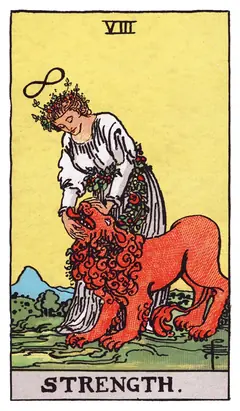
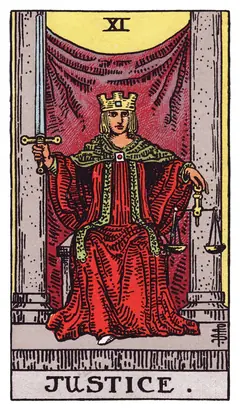
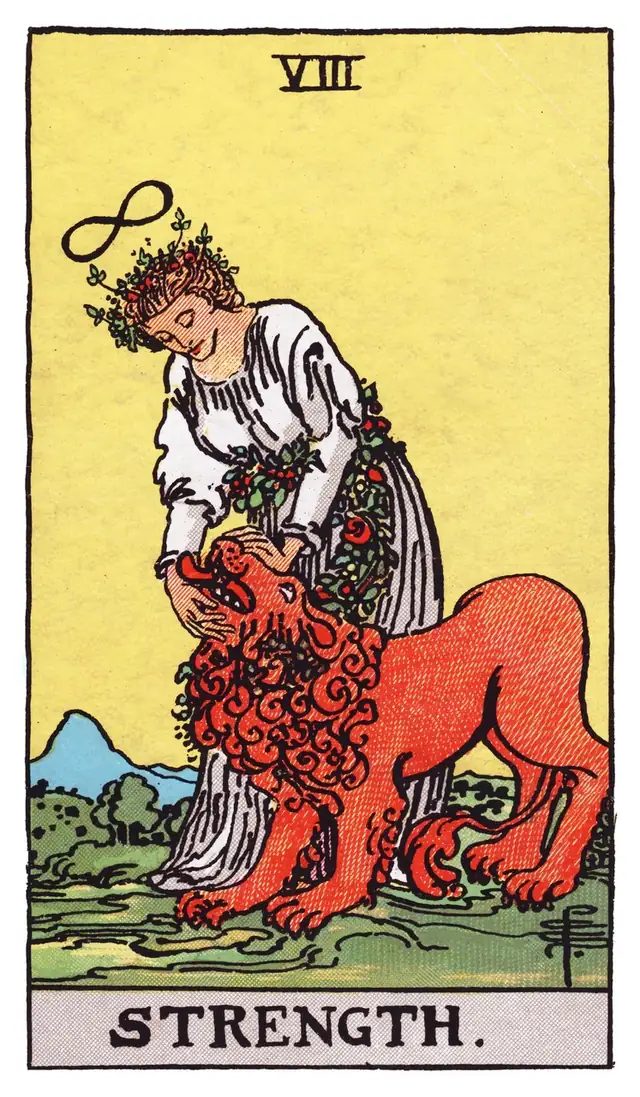
To make the zodiac fit. Once the Fool was given Aleph, the signs of the zodiac fell on the trumps in order, except at one point: Leo, the lion, landed on Justice and Libra, the scales, on Strength. The order put the lion on the card with the lion and the scales on the card with the scales by moving Strength to VIII and Justice to XI.[2]
Waite printed the swap on the Rider–Waite–Smith in 1909, which is why most decks today number Strength VIII. Crowley kept the signs but put the old numbers back on his Thoth deck, where Adjustment is VIII and Lust XI. Marseille-pattern decks never changed. See Why Strength is 8 and Justice 11.
How did the Golden Dawn shape modern tarot?
Through two decks. The Rider–Waite–Smith (1909) follows the order's system but does not print it: Waite had sworn secrecy, and his cards carry no letters or signs. Smith's scenes for the numbered cards often match the Book T titles, and readers have traced many of them to the decans. The Thoth tarot, painted by Frieda Harris for Crowley between 1938 and 1943, does the opposite and puts the system on the face of every card.[2]
Several later decks were made to show the order's tarot as its members knew it: the Golden Dawn Tarot by Robert Wang, drawn under Israel Regardie's guidance in the late 1970s; the Hermetic Tarot by Godfrey Dowson; and the Golden Dawn Magical Tarot by Chic and Sandra Tabatha Cicero.
How did the secret teachings become public?
In stages. Crowley broke his oath first, printing rituals in his journal The Equinox from 1909 and the order's tables of correspondence in his book 777 the same year. The full papers came out in 1937–1940, when Israel Regardie, once Crowley's secretary and later a member of a Golden Dawn successor order, published them in four volumes as The Golden Dawn, Book T included.[3] From then on, anyone could learn the system without joining anything.
What happened to the Golden Dawn?
It lasted barely twelve years in one piece. Mathers, living in Paris, ruled from a distance and grew more autocratic; in 1900 the London adepts rebelled, and Crowley, on Mathers's side, tried and failed to seize the order's rooms. By 1903 there were rival orders: Mathers's Alpha et Omega, the Stella Matutina, and Waite's branch, which kept the temple name Isis-Urania and turned to Christian mysticism.[1] The last temples of the Stella Matutina closed in Bristol in 1970 and in New Zealand in 1978. Several modern groups use the name today.
Do you need the Golden Dawn to read tarot?
No. The correspondences are one layer that some readers find rich and others ignore. Plenty of people read the Rider–Waite–Smith for years from the pictures alone, and the Marseille tradition never used the Golden Dawn system at all. Knowing it helps you understand why a deck looks the way it does, and why the Thoth deck is the way it is. See Rider–Waite–Smith vs Marseille and Thoth tarot.