The order of the Major Arcana
History · 3 min read · updated
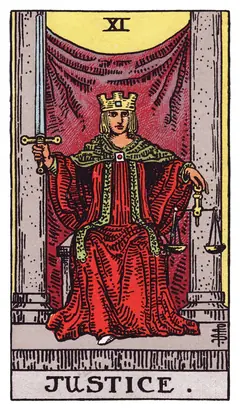
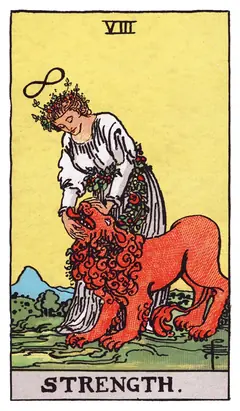
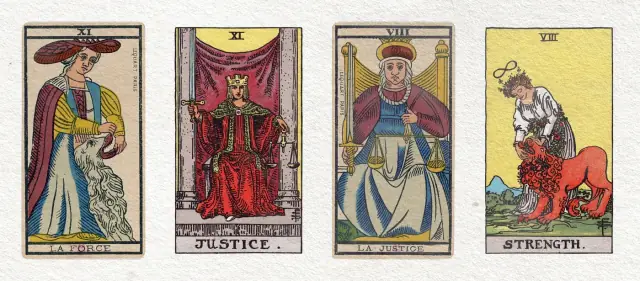
The 22 Major Arcana have not always run in one order. In 15th-century Italy each region ranked the trumps differently and most cards carried no numbers at all; the sequence most people know, from the Magician at I to the World at XXI, was fixed by the Tarot de Marseille in the 17th century. The best-known change since is the Golden Dawn's swap of Strength and Justice, which is why Strength is VIII in the Rider–Waite–Smith and XI in the Marseille.
- Cards
- Earliest decks
- Unnumbered, about 1440
- Regional orders
- Three main families in Italy
- Standard order
- Tarot de Marseille, 17th century
- Strength–Justice swap
- Fool
- Unnumbered, later 0
Why were the trumps put in order?
Because tarot was a game. Trumps beat ordinary cards, and a higher trump beats a lower one, so every player had to know which outranked which. The earliest hand-painted decks, made for the courts of Milan and Ferrara around 1440, have no numbers on the trumps; players learned the order by heart, much as people know that a queen beats a jack.[1] See Tarot as a card game.
Did everyone use the same order?
No. The historian Michael Dummett, comparing old decks, rule books and lists, found three families of order in Renaissance Italy, which he named A, B and C.[1]
- A, the southern order (Bologna, Florence): the three virtues, Temperance, Fortitude and Justice, sit low and close together, and the Angel, the Last Judgement, is the highest trump, above the World.
- B, the Milan order: the one the Tarot de Marseille inherited, with Justice at VIII, Strength at XI and the World at the top.
- C, the Ferrara order (Ferrara, Venice): Justice is moved up near the top, between the Angel and the World.
In every family the lower trumps show human life, the Popes, the Emperors and the Lovers, the middle show Fortune, Time and Death, and the top show the heavens: the Star, the Moon, the Sun, the Judgement and the World. That rise, from earth to heaven, is the real logic of the series.
How did the Marseille order become standard?
When tarot reached France and Switzerland it travelled in the Milan form, and the woodcut decks of the 17th and 18th centuries, now called the Tarot de Marseille, printed Roman numerals on the trumps. Those numbers fixed the order for everyone who used the deck, and through Court de Gébelin in 1781 they became the order the occultists studied. In the Marseille, Justice is VIII, Strength XI and Death XIII, the one trump printed without a name.
Why are Strength and Justice swapped?
The swap comes from the Golden Dawn. It linked each trump to a Hebrew letter and, through the letter, to a sign of the zodiac. With the Fool on the first letter, the signs fell in order everywhere except at VIII and XI, where Justice would have been Leo and Strength Libra. Since a lion belongs to Leo and scales to Libra, the order swapped the two cards to put each beside its sign.[2]
A. E. Waite printed the change in the Rider–Waite–Smith in 1909, saying only that it satisfied him for reasons he would not explain. Because that deck took over the English-speaking world, most readers now know Strength as VIII and Justice as XI. The Marseille kept the old numbers, and the Thoth kept them too, as Adjustment VIII and Lust XI. Neither order is wrong; check the number on your own deck.
Where does the Fool go?
Nowhere, at first. The Fool was not a trump in the game but an excuse: a card that could be played instead of following suit, and it had no number. Occultists had to place it to match it with a letter. Lévi put it between XX and XXI; the Golden Dawn put it first, as 0. Most modern decks follow the Golden Dawn, which is why the Fool's Journey starts with the Fool.
Other orders
- Minchiate, a Florentine game, has 40 trumps, adding the virtues, the elements and the twelve signs. See .
- Etteilla's deck renumbered all 78 cards into one series beginning with the creation. See Etteilla.
- The Thoth also swaps the Emperor and the Star in its letters, though not in its numbers.