The Fool's journey
Symbols and systems · 4 min read · updated
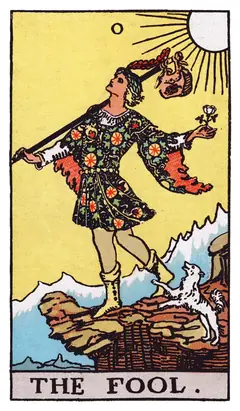
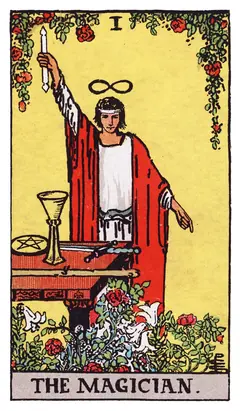
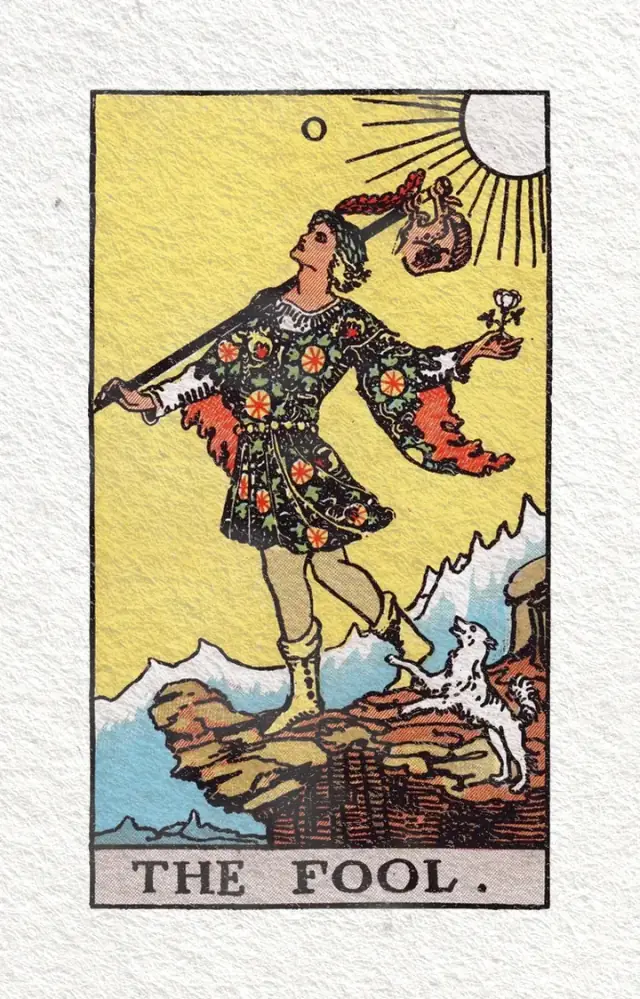
The Fool's journey is a way of reading the 22 Major Arcana as one story. The Fool, card 0, is the traveller, and each trump from the Magician (I) to the World (XXI) is a person met or a lesson learned on the road. It is a modern teaching device, not part of tarot's original design.
- Cards
- The 22 Major Arcana
- Starts
- The Fool, 0
- Ends
- The World, XXI
- Common layout
- Three rows of seven, with the Fool apart
- Origin
- 20th-century tarot teaching
- Use
- Learning the Majors; placing a card in a story
What is the Fool's journey?
The are numbered, so they can be read in order like the chapters of a book. The Fool's journey gives that order a hero. The Fool sets out with nothing but a bag and a dog, and every after it is a stage of growing up: meeting teachers and rulers, falling in love, being tested, losing everything, and coming out whole.
Teachers use it because a story is easier to remember than 22 lists of keywords. Each card gets a place: before it, after it, what it leads to. The Fool stands for anyone at the start of something new, which is why readers say every reading can be seen as a stretch of the same road.
Where does the Fool's journey come from?
Not from the 15th century. The first trumps, made for the card game trionfi in northern Italy, were a ranking: each card beat the one below it. The Fool was not a trump at all but a card that let a player avoid following suit, and in the game it stood apart from the sequence.[1] Some scholars link the order of the trumps to Renaissance triumph processions, in which one virtue or power overcomes another, but that is a parade, not a quest.
The idea of the Fool as a traveller through the other trumps belongs to 20th-century tarot writing. Occultists had already argued over where the Fool belonged: A. E. Waite gave it 0 but discussed it between Judgement and the World.[2] In the second half of the 20th century, popular tarot books in English presented the Majors as stages of a life or of inner growth, often with ideas borrowed from Carl Jung's , and the phrase Fool's journey became the standard way to teach them.
What are the three stages of the Fool's journey?
A common layout puts the Fool on its own and the other 21 cards in three rows of seven. Readers describe the rows roughly like this:
- Row one, I to VII: the outer world. Skills, parents, teachers, choices, setting off with confidence.
- Row two, VIII to XIV: the inner world. Courage, solitude, chance, consequence, letting go, finding balance.
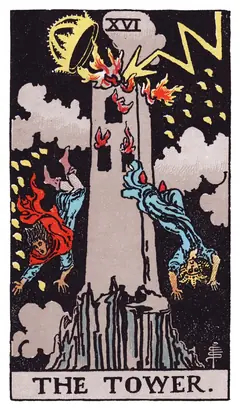
- Row three, XV to XXI: the deep and the cosmic. Bondage and collapse, then hope, illusion, light, renewal and completion.
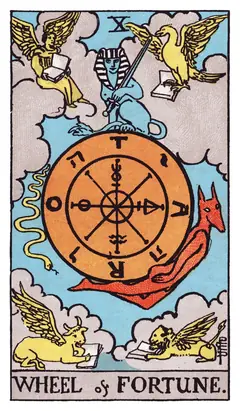
Other teachers split the cards into two halves around the Wheel of Fortune, or into the four seasons. None of these is the correct one; each is a way of seeing patterns.
The Fool's journey card by card
One line per card. Each name leads to the card's page and its full free meaning.
- The Fool (0): the traveller sets out, open to anything.
- The Magician (I): the tools are on the table.
- The High Priestess (II): what is sensed but not yet said.
- The Empress (III): growth, care, plenty.
- The Emperor (IV): order, rules, a father figure.
- The Hierophant (V): tradition and teachers.
- The Lovers (VI): a bond and a choice of values.
- The Chariot (VII): will, pushing forward.
- Strength (VIII): courage that is patient rather than forceful.
- The Hermit (IX): stepping back to look within.
- Wheel of Fortune (X): change beyond anyone's control.
- Justice (XI): fairness and consequences.
- The Hanged Man (XII): a pause, the world seen upside down.
- Death (XIII): an ending that clears space.
- Temperance (XIV): mixing, moderation, the middle way.
- The Devil (XV): what binds and tempts.
- The Tower (XVI): a false structure falls at once.
- The Star (XVII): hope after the storm.
- The Moon (XVIII): doubt, dreams, the uncertain path.
- The Sun (XIX): clarity and plain joy.
- Judgement (XX): a call to rise and take stock.
- The World (XXI): the circle closes; a new one can begin.
In decks that keep the older order, such as the Tarot de Marseille, Justice is VIII and Strength XI, and the story shifts a little. See Numbers in tarot.
How to use the Fool's journey in a reading
- When a Major comes up, ask where it sits on the road. Early cards suggest a beginning, late cards a matter near its end.
- Look at the cards either side of it in the sequence. The card before is often what led here; the card after, what it is turning into.
- If several Majors appear, put them in number order and read them as a short stretch of the journey.
- Lay out all 22 cards in the three rows and write a sentence for each. It is one of the quickest ways to learn the Majors, and a good first page for a tarot journal.
The journey is a loop, not a line. After the World the Fool sets out again, which is why many readers say the story fits any new start, large or small.