Numbers in tarot
Symbols and systems · 4 min read · updated
Tarot numerology is the habit of reading a card through its number. In the Minor Arcana the numbers Ace to Ten follow the same arc in every suit, from a beginning to a completed cycle, and many readers link the 22 Major Arcana to those numbers too by adding their digits.
- Numbered cards
- 40 pips, Ace to Ten in four suits
- Major Arcana
- 0 or unnumbered, then I to XXI
- Reduction
- Add the digits: XIII → 1 + 3 = 4
- Court cards
- No number in most systems
- First trumps
- 15th century, with no numbers
- Swap
What is tarot numerology?
Every in a deck has a number from Ace to Ten, and every card except the Fool has a numeral. in tarot treats that number as a second layer of meaning on top of the suit and the picture. Learn ten numbers and four suits and you already have a rough sense of all 40 numbered cards.
It is a reading method, not a hidden code built into the deck. The cards were made for a game, and their numbers were first an order of play. The meanings readers give the numbers today come from 19th- and 20th-century occult writing and from modern teachers.
What do the numbers mean in tarot?
Books differ in wording but agree on the broad arc. Read across the suits, it runs like this:
- 0 (the Fool): open potential, before anything is fixed.
- 1 (Aces): a seed. The suit at its purest and simplest.
- 2: a pairing or a choice. Two things in balance or in tension.
- 3: first growth. Something takes shape, often with other people.
- 4: stability. A structure, a pause, sometimes a standstill.
- 5: disruption. The stable four is shaken; conflict or loss pushes change.
- 6: recovery and exchange. Things settle into a new balance.
- 7: a test. Taking stock, holding a position, looking inward.
- 8: movement and effort. Work under way, speed, skill.
- 9: near the end. The suit at its most intense, good or bad.
- 10: the cycle complete. Fullness, and sometimes too much of it.
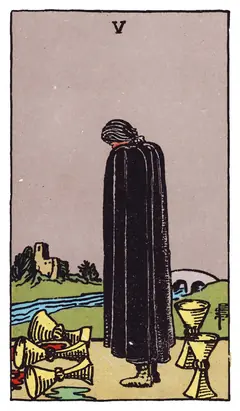
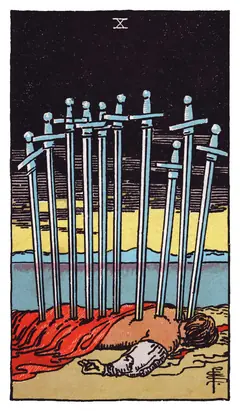
Put a number with its suit and the card often explains itself. A Five in Cups is a loss of feeling, a Five in Pentacles a loss of means: compare the Five of Cups and the Five of Pentacles. A Ten in Swords is thought pushed to its end, as on the Ten of Swords. See Tarot suits.
How are the Major Arcana numbered?
The first trump cards, painted in Italy in the 15th century, carried no numbers at all, and the order of the trumps differed from city to city.[1] Printed numerals became standard later; the Tarot de Marseille has Roman numerals I to XXI and leaves the Fool without one.
Most modern decks follow the order of the Rider–Waite–Smith deck, which keeps the Marseille sequence with one change: Strength becomes VIII and Justice XI. Waite said he made the swap for reasons that satisfied him, without explaining them; the change follows the Golden Dawn's astrological scheme.[2] Marseille-style decks still have Justice at VIII. See Major and Minor Arcana.
How do you reduce a Major Arcana number?
To link a trump to the numbers 1 to 9, add its digits until one digit is left:
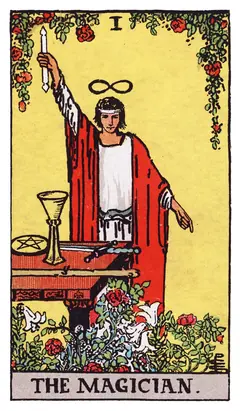
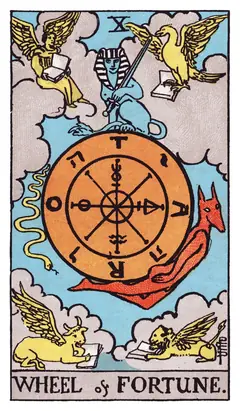
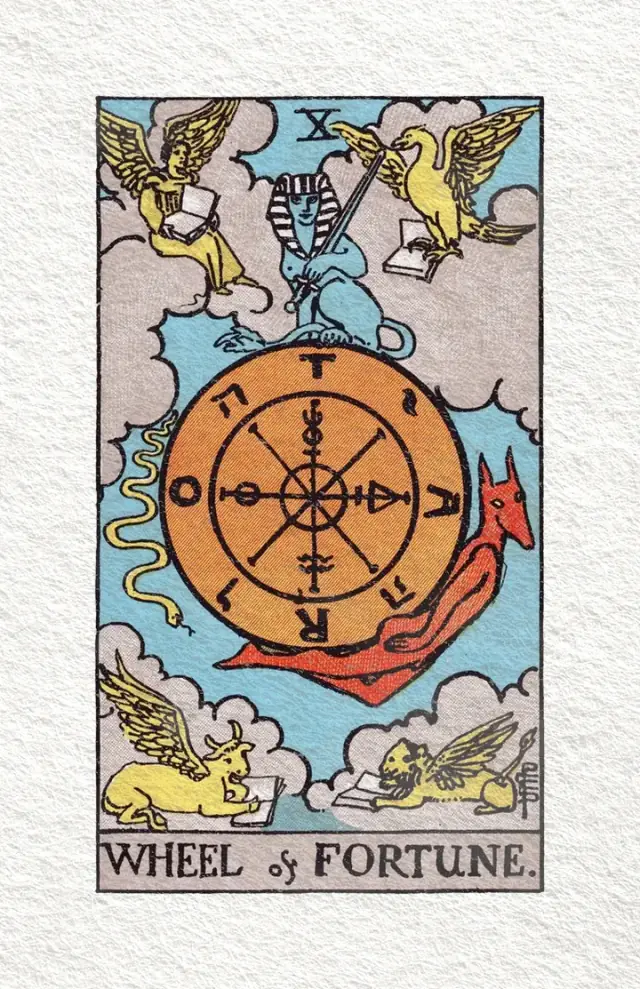
- Wheel of Fortune (X): 1 + 0 = 1, paired with the Magician (I).
- Death (XIII): 1 + 3 = 4, paired with the Emperor (IV).
- The Sun (XIX): 1 + 9 = 10, then 1 + 0 = 1.
- The World (XXI): 2 + 1 = 3, paired with the Empress (III).
This gives families of cards that readers say share a theme: I, X and XIX are all about starting or a turn. Some Marseille readers use a different method and pair each trump with the one ten places on, I with XI, II with XII, so the numbers add rather than reduce.
The same arithmetic links Majors to pips: a reader who draws the Emperor next to a Four sees the theme of structure doubled.
What about court cards and the Fool?
have no number in most systems. A few readers count them as 11 to 14, Page to King, but the common approach is to read them as people or roles instead. See Court cards.
The Fool is the odd one out. In the old card game it was not a trump but a card that excused you from following suit.[1] Readers give it 0, and some give it 22, putting it at the end of the series instead of the start. See The Fool's journey.
How to use numbers in a reading
- Lay the spread and, before reading any single card, count the numbers.
- Look for a repeat. Three Fives, say, put disruption at the centre of the question, whatever the suits.
- Look for a run. Cards climbing from low to high can show something under way; a spread full of Nines and Tens points to an ending.
- Read low and high numbers as early and late: Aces and Twos at the start of a matter, Tens at its close.
- Note any Major whose reduced number matches a pip in the spread, and read the two together.
What is a tarot birth card?
A is a Major Arcana card worked out from a date of birth, a method popularised by the American writer Mary K. Greer. Add the day, the month and the full year, then add the digits of the total until it is 21 or less. For 14 March 1990: 14 + 3 + 1990 = 2007, and 2 + 0 + 0 + 7 = 9, the Hermit. A total from 10 to 21 gives two cards, that number and its reduction. A works the same way with the current year in place of the birth year.
There is no historical basis for birth cards; they are a modern prompt for reflection, and many readers enjoy them in that spirit.