Tarot symbols
Symbols and systems · 4 min read · updated
Tarot symbols are the pictures that recur from card to card: pillars, the infinity sign, roses and lilies, water, the moon and sun, mountains, lions and the four winged creatures. Most of the familiar set comes from the Rider–Waite–Smith deck of 1909, which drew on Christian art, astrology and the teachings of the Golden Dawn.
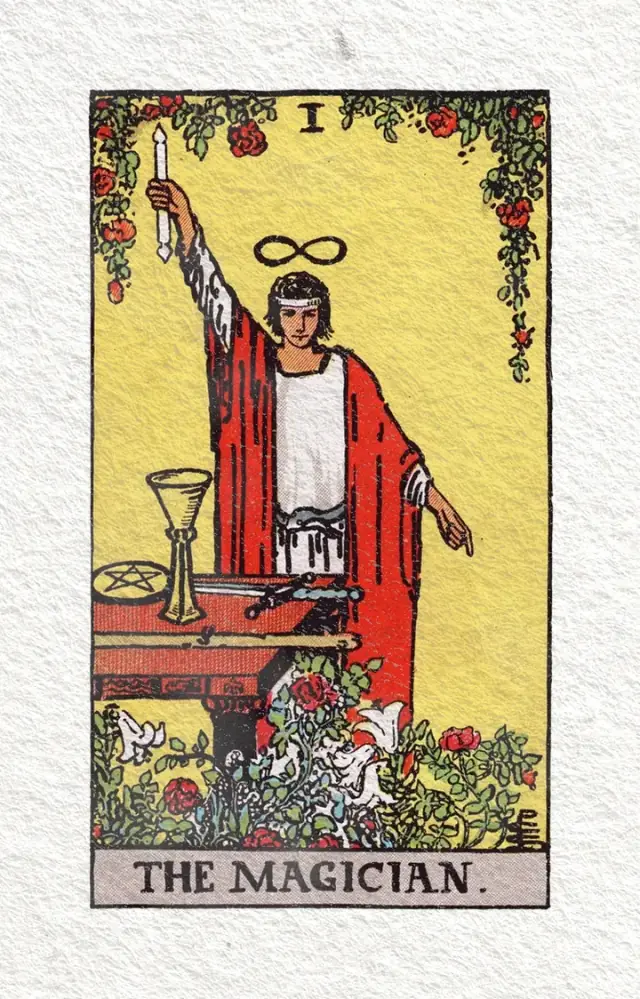
- Most symbols from
- Rider–Waite–Smith, 1909
- Designed by
- Pamela Colman Smith, with A. E. Waite
- Sources
- Christian art, astrology, the Golden Dawn
- Older decks
- Fewer symbols, simpler pictures
- Reading rule
- A symbol shifts with the card around it
Why do tarot symbols repeat?
A is a visual vocabulary. When the same object appears on several cards, readers take it as a thread that ties them together: a pool of water on one card echoes the stream on another. The early Italian and Marseille decks used a small set of images taken from the art of their time. Pamela Colman Smith and A. E. Waite added far more, giving almost every card a scene and loading it with details from Christian iconography, astrology and the Golden Dawn's system of .[1]
So most lists of tarot symbols, including this one, describe the Rider–Waite–Smith deck and its many copies. Other decks may share a symbol or drop it.
Common tarot symbols and their meanings
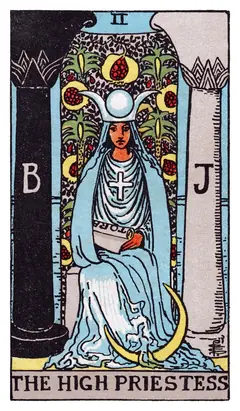
- Two pillars, one black and one white, stand either side of the High Priestess, marked B and J. Waite took them from Boaz and Jachin, the bronze pillars of Solomon's temple.[2] Readers see opposites held in balance: light and dark, known and hidden. Pillars also frame the Hierophant and Justice.
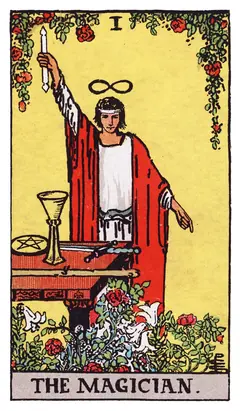
- The infinity sign, a figure eight on its side, floats over the head of the Magician and the woman of Strength. Waite called it a sign of life, like an endless cord.[2] Readers take it as unlimited potential, or mastery that does not run out.
- Roses and lilies grow together in the Magician's garden. Red roses are read as desire and passion, white lilies as purity and clear thought; together, the heart and the mind. The Fool carries a white rose, and Death's banner bears one.
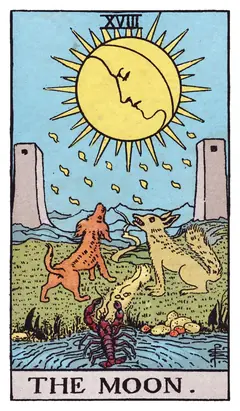
- Water is feeling, the unconscious and intuition, which is why it runs through the suit of Cups. It pools at the feet of the Star and the Moon, flows behind the High Priestess, and one foot of Temperance stands in it.
- The moon stands for intuition, cycles, dreams and things half seen. A crescent lies at the High Priestess's feet and rides on the Chariot's shoulders; the full face fills the Moon card.
- The sun is clarity, life and consciousness. It blazes on the Sun card, rises behind Death, and shines in the sky of many cheerful scenes.
- Mountains are effort, distance and achievement. The Fool walks towards a cliff, the Hermit stands on a peak, and far mountains wait in the background of the Lovers and the Eight of Cups.
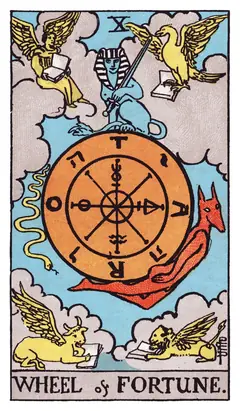
- The lion is courage, appetite and the sign of Leo. It appears with Strength, at a corner of the Wheel of Fortune and on the throne of the Queen of Wands.
- The four winged creatures, an angel, an eagle, a lion and a bull, sit in the corners of the Wheel of Fortune and the World. In Christian art they stand for the four Gospel writers; tarot readers also link them to the fixed signs Aquarius, Scorpio, Leo and Taurus, and to the four elements.
- The snake is renewal and wisdom, since snakes shed their skin. The Magician's belt is a snake eating its own tail.
- Keys are knowledge and authority. The crossed keys at the feet of the Hierophant recall the keys of Saint Peter.
- Dogs and wolves are instinct, tame and wild. A small dog jumps at the Fool's heels; a dog and a wolf howl under the Moon.
- The blindfold is not seeing, or not wanting to see, as on the Two and the Eight of Swords.
- Pomegranates and wheat are fertility and harvest: pomegranates on the High Priestess's veil and the Empress's dress, ripe wheat at the Empress's feet.
What do colours mean in tarot?
Smith used colour with care, and readers have built a loose code from it. Yellow skies are read as optimism and awareness, grey skies as doubt or a hard time, red as passion and action, blue as calm and the inner life, white as purity, and black as mystery or grief. Treat these as hints, not rules: the same red that means drive on one card can mean anger on another.
How to read symbols in a spread
- Look at the whole picture first, then pick out the details that catch your eye.
- When a symbol appears on two or more cards in a , read those cards as a pair.
- Let the card decide the tone. Water on a calm card is peace; water on a stormy one is turmoil.
- Note your own associations. If a symbol means something specific to you, that meaning counts in your .
For what each card means as a whole, follow its link to the card page. See also The Fool's journey and Tarot and astrology.