Arthur Edward Waite
People · 3 min read · updated
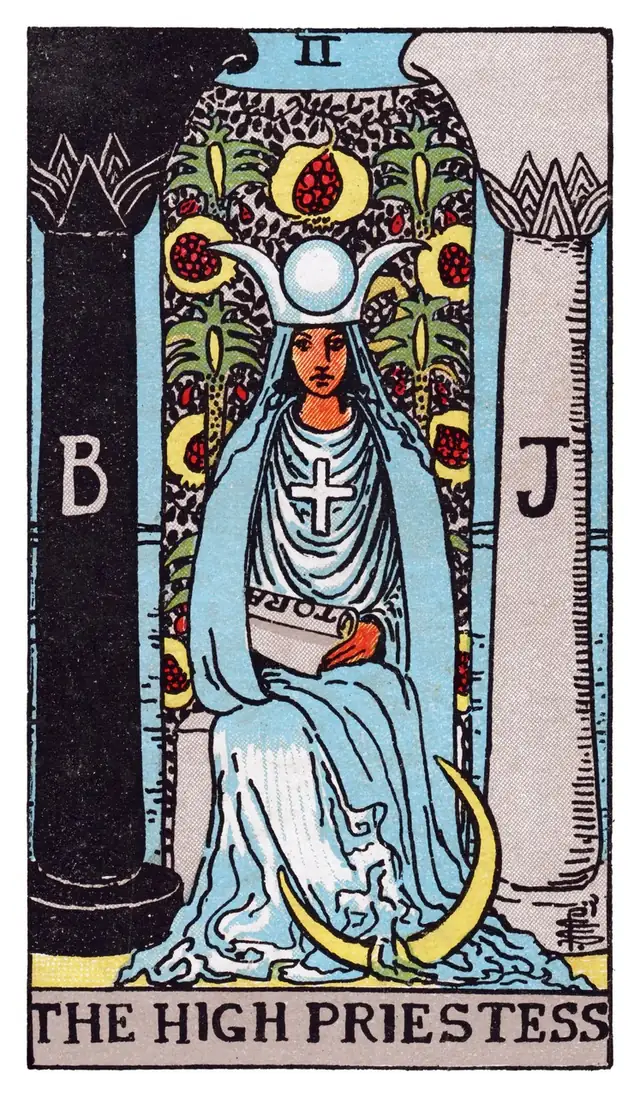
Arthur Edward Waite (1857–1942) was a British writer on mysticism and the occult who planned the Rider–Waite–Smith tarot, published in London in 1909 with 78 cards drawn by Pamela Colman Smith, and wrote its guide, The Pictorial Key to the Tarot. A member of the Golden Dawn and later leader of one branch of it, he wrote dozens of books on magic, the Kabbalah, Freemasonry and the Holy Grail.
- Known for
- Rider–Waite–Smith tarot, 1909
- Artist
- Pamela Colman Smith
- Tarot books
- The Key to the Tarot, 1910; The Pictorial Key to the Tarot, 1911
- Golden Dawn
- From 1891; led a branch from 1903
- Publisher
- William Rider & Son, London
- Other subjects
- Kabbalah, Freemasonry, alchemy, the Grail
Who was A. E. Waite?
Waite was born in Brooklyn to unmarried parents. His father, an American sea captain, died at sea when he was a baby, and his English mother, Emma Lovell, took him back to England, where he grew up in north London. He had little formal schooling and educated himself, much of it in the reading room of the British Museum, while working as a clerk and writing poetry.
He found his subject in his twenties, reading Éliphas Lévi, and spent the next sixty years writing about the hidden traditions of Western religion: magic, alchemy, the Rosicrucians, the , Freemasonry and the Grail legends. His first big book, The Mysteries of Magic (1886), was a digest of Lévi. Unlike many occult writers of his time he tried to work from documents, and he was quick to say when a cherished story had none behind it. He married Ada Lakeman in 1888; they had one daughter, Sybil.
Waite and the Golden Dawn
Waite joined the Hermetic Order of the Golden Dawn in January 1891, left it in 1893, came back in 1896 and entered its inner order in 1899. When the order split, in 1903, he and a fellow member took over its London temple and steered it away from magic towards Christian mysticism.[1] Pamela Colman Smith, who had joined in 1901, went with him. His branch broke up in 1914, and in 1915 he founded a new group, the Fellowship of the Rosy Cross.
The Golden Dawn gave Waite his tarot. Its members learned a system that tied each card to astrology and the Hebrew alphabet, and swore to keep it secret. Waite kept that oath, and it shaped his deck. See The Golden Dawn.
How did Waite create the Rider–Waite tarot?
In 1909 Waite asked Smith to draw a complete new deck of 78 cards. She did it in about six months, and William Rider & Son published it in London in December 1909, with Waite's short guide, The Key to the Tarot.[2] An expanded edition with a plate of every card, The Pictorial Key to the Tarot, followed in 1911.[3]
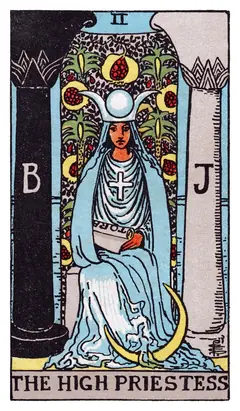
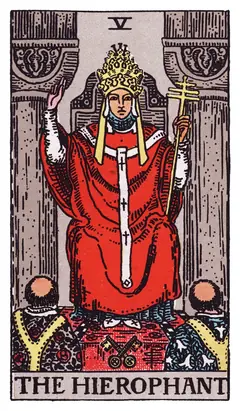
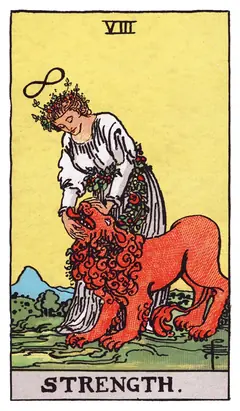
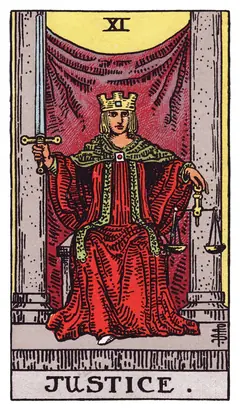
Waite directed the trumps closely. He renamed some cards, turned the coins of old decks into pentacles, and printed the Golden Dawn's swap of Strength and Justice, saying only that he had reasons that satisfied him.[3] He changed the Popess of the old decks into the High Priestess and the Pope into the Hierophant.
The numbered cards are another story. Waite's book gives them only short notes, and the scenes on all 56 cards are generally credited to Smith's own invention, some borrowed from the Sola Busca tarot of 1491.[2] Those scenes are the main reason the deck took over the world.
What did Waite write about tarot?
The Pictorial Key has three parts: a history of the cards, a description of each card with its symbols, and a short guide to divination with brief meanings, upright and reversed, for all 78. It also printed a ten-card Waite called an ancient Celtic method, now known as the , and made it the most used large spread in English.[3] See Celtic Cross spread.
Two things in the book surprise modern readers. Waite dismissed the claim that tarot came from ancient Egypt, saying nothing proved the cards existed before the 14th century. And he said openly that he was holding back part of what he knew, because of his oath to the Golden Dawn.[3] See Myths about tarot's origins.
Why is it called the Rider–Waite tarot?
For most of the 20th century the deck was known by its publisher and its author, Rider and Waite. Smith was paid a fee and her name was not on the box. Since the late 20th century many writers have called it the Rider–Waite–Smith, or RWS, to give the artist her place, and that is the name this wiki uses.
Waite's other books
- The Mysteries of Magic, 1886, his digest of Lévi.
- The Book of Ceremonial Magic, 1911, a study of the old grimoires.
- The Hidden Church of the Holy Graal, 1909, the first of his books on the Grail.
- The Holy Kabbalah, 1929.
- Shadows of Life and Thought, 1938, his memoirs.
Waite's prose is dense and his tone often grand, and few of these are read now outside specialist circles. His tarot is the exception: more than a century later, most people who learn tarot learn it on cards he planned. His younger Golden Dawn rival Aleister Crowley, who mocked him in print, made the other great English deck of the century.