Myths about tarot's origins
History · 4 min read · updated
No, tarot did not come from ancient Egypt, and it was not brought to Europe by the Romani, once called gypsies. The Egyptian story was invented in Paris in 1781 and the Romani one in the 19th century. The documents show tarot was made in northern Italy around 1440, as a card game, centuries after the civilisations it was later credited to.
- Real origin
- Northern Italy, c. 1440, as a card game
- Egyptian claim
- Court de Gébelin, Paris, 1781
- "Book of Thoth"
- Comte de Mellet, 1781
- Romani claim
- J.-A. Vaillant, 1857; Papus, 1889
- Hebrew letters
- Éliphas Lévi, 1854–1856
- Evidence for any of them
- None
Did tarot come from Egypt?
No. The idea has a precise birthday. In 1781 Antoine Court de Gébelin, a Protestant pastor and scholar in Paris, published an essay in the eighth volume of his encyclopedia Le Monde primitif. He said he had seen a game of being played at a friend's house and recognised at once that the pictures were an ancient Egyptian book, saved from the burning of the temples and disguised as a game. In the same volume an essay by the Comte de Mellet named it the Book of Thoth, after the Egyptian god of writing.[1]
Neither man offered evidence, and none could have existed. Egyptian hieroglyphs were unreadable until Jean-François Champollion deciphered them in 1822. Court de Gébelin's etymology, that tarot came from Egyptian words for "royal road", was a guess; no such words have been found. Once the hieroglyphs could be read, nothing in them mentioned cards, and no Egyptian object looks like a tarot card.
The real story is in Italian archives. Playing cards reached Europe in the 1370s, and the first record of tarot, then called trionfi, is from Florence in 1440.[2] The cards Court de Gébelin saw were a Tarot de Marseille, a French printed pattern of the 17th century. See History of tarot.
Why did people believe the Egyptian theory?
Late 18th-century Paris was ready for it. Educated readers believed that Egypt had been the source of all ancient wisdom, an idea inherited from Renaissance writings attributed to Hermes Trismegistus, and Freemasons, Court de Gébelin among them, used Egyptian symbols in their lodges. A picture book of kings, popes, Death and the Devil, with a numbered sequence of 22 cards, looked like exactly the kind of coded wisdom they hoped to find.
The theory then found a market. Within two years a Parisian card reader, Jean-Baptiste Alliette, who wrote as Etteilla, was selling books on reading tarot as the Book of Thoth, and in 1789 he published the first deck designed for , with Egyptian themes.[1] Every occult tarot since descends from this moment.
Did the Romani (gypsies) bring tarot to Europe?
No. The dates rule it out. Ordinary playing cards were already in Italy, Spain and France in the 1370s, and the first Romani groups are recorded in western Europe only in the 1410s. By then cards were a common pastime, banned and taxed in many cities.
The Romani story was built on top of the Egyptian one. "Gypsy" itself comes from "Egyptian", because Europeans wrongly believed the Romani had come from Egypt; their real origin is in north-west India. In 1857 the French writer Jean-Alexandre Vaillant argued that the Romani had carried tarot across the world, and in 1889 the occultist gave his famous book the title Le Tarot des Bohémiens, the tarot of the gypsies.[1] Neither had any historical record to point to.
What is true is that some Romani women in the 19th and 20th centuries told fortunes with cards, usually an ordinary pack, and the image of the "gypsy fortune-teller" became a stock figure in fiction and at fairgrounds. That image sold decks for a century. It also attached a slur and a stereotype to a real people, which is why many writers today avoid the word "gypsy" for either.
Is tarot based on the Kabbalah?
No, though the link was made so well that most tarot books repeat it. The 22 trumps happen to match the 22 letters of the Hebrew alphabet. In the 1850s the French occultist Éliphas Lévi paired each trump with a letter and placed the whole deck inside the , the Jewish mystical tradition.[1] Later the Golden Dawn in London built its own, different set of letter pairings, which most English-language books now follow.[3]
Nothing suggests that the Italian card painters of the 15th century knew Hebrew or the Kabbalah, and the number of trumps was not fixed at 22 in the early decks: some had more, some fewer. The correspondences are a 19th-century system laid over the cards, useful to readers who like them, not a key that was hidden in them. See Tarot and the Kabbalah.
Other tarot origin stories
- India. Some 19th- and 20th-century writers linked the four suits to the emblems of Hindu gods or to Indian chess. There is no line of descent from either to the Italian cards.
- The Cathars or the Knights Templar. Both died out or were suppressed long before 1440, and no record ties them to cards.
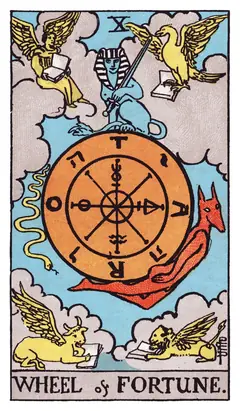
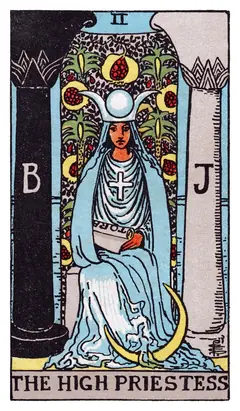
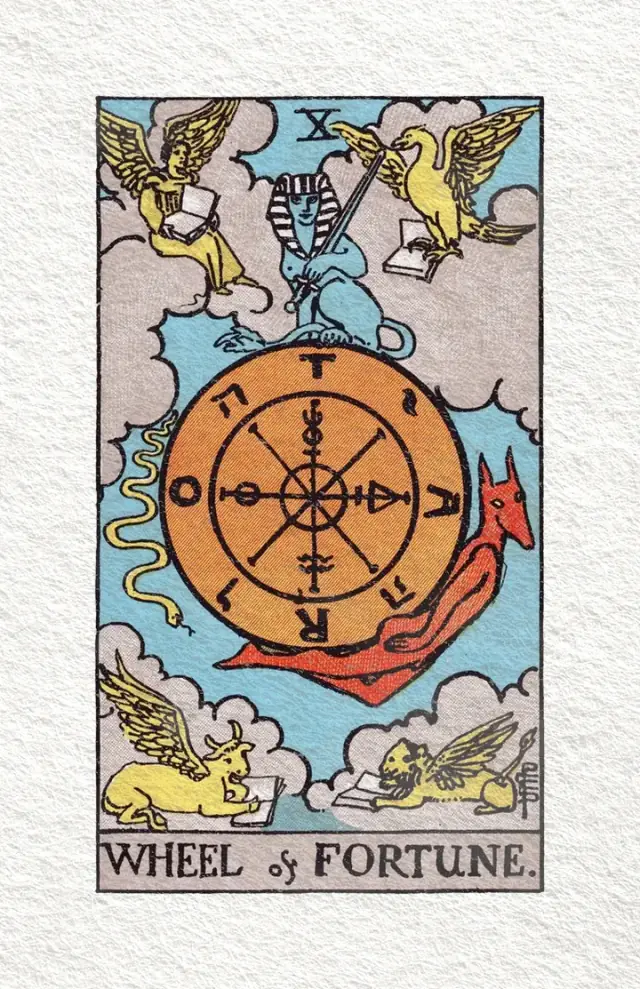
- A hidden word. Lévi and later the Golden Dawn read TARO as an anagram of rota, Latin for wheel, and of Torah. Waite and Smith wrote the letters around the Wheel of Fortune and on the scroll of the High Priestess. It is a word game, not an etymology; nobody knows where the word tarocchi comes from.
- Atlantis and lost civilisations. These appear in 20th-century occult books and have no evidence behind them at all.
Why the myths still matter
The myths are false history, but they are real history of another kind. Without Court de Gébelin there would be no Etteilla, no Lévi, no Golden Dawn and no Rider–Waite–Smith deck. Even Arthur Edward Waite, who owed everything to that tradition, wrote in 1911 that the Egyptian origin had never been proved and that the cards could not be traced before the 14th century.[4] The leading historians of the cards, Michael Dummett and his colleagues, reached the same conclusion with far better documents.
None of this takes anything away from tarot. The symbols on the cards mean what generations of readers have put into them, and that living tradition is where the deck's power comes from. Knowing where the cards really came from just keeps the story straight.