Tarot as a card game
History · 5 min read · updated
Tarot is a card game before it is anything else: the 78-card deck was invented in 15th-century Italy for a trick-taking game, and that game is still played across Europe. The best-known version today is French Tarot, in which one player, the taker, bids to win a set number of card points from the tricks against everyone else at the table.
- Type
- Trick-taking game with trumps
- Invented
- Northern Italy, c. 1440, as trionfi
- Best-known form
- French Tarot
- Players
- 3 to 5, usually 4
- Deck
- Also played in
- Austria, Hungary, Slovenia, Czechia, Italy, Switzerland, south Germany
Is tarot a card game?
Yes, and it was nothing else for its first three centuries. The pack appeared in the courts of Milan, Ferrara and Florence around 1440 as the game of trionfi, "triumphs": an ordinary four-suit pack with a fifth suit of picture cards added to beat all the others.[1] Those picture cards are the ancestors of the , and the word "trump" in many card games comes from the same idea.
Using the cards for fortune-telling is first recorded around 1750, in Bologna, and the occult tarot of books and readers grew up in Paris and London after that.[1] Meanwhile the game kept spreading. Rabelais lists it among the games of Gargantua in 1534, and the Abbé de Marolles printed the earliest detailed rules in 1637. See History of tarot.
Where is tarot played today?
Tarot games are a living tradition in a wide belt of Europe, each country with its own rules and often its own deck.[1]
- France: French Tarot, one of the most played card games in the country, with clubs and tournaments.
- Austria, Slovenia and Romania: Königrufen, "calling the king", played with a 54-card Tarock pack.
- Hungary: Hungarian Tarokk, often called the hardest of the tarot games.
- Czechia and Slovakia: games in which the taker calls a trump as partner.
- Italy: Tarocchini in Bologna, tarocchi in Sicily and Piedmont, still with the old Italian suits.
- Switzerland: Troccas in the Grisons and Troggu in the Valais.
- South-west Germany: Cego, a Baden game played with a 54-card pack.
Almost none of these decks are the ones readers use. Most game packs have French suits (hearts, diamonds, clubs, spades) and trumps that show scenes of everyday life, animals or landscapes rather than the Magician and the Moon. Many, like the Austrian Tarock pack, are shortened to 54 or 42 cards.
What deck is used for French Tarot?
French Tarot uses the full 78 cards.[2]
- Four of 14 cards: hearts, diamonds, clubs and spades, each with King, Queen, Knight (cavalier), Jack (valet) and 10 down to 1.
- 21 (atouts), numbered 1 to 21. The higher number always wins.
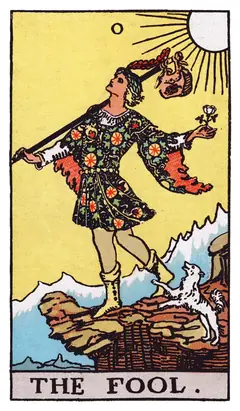
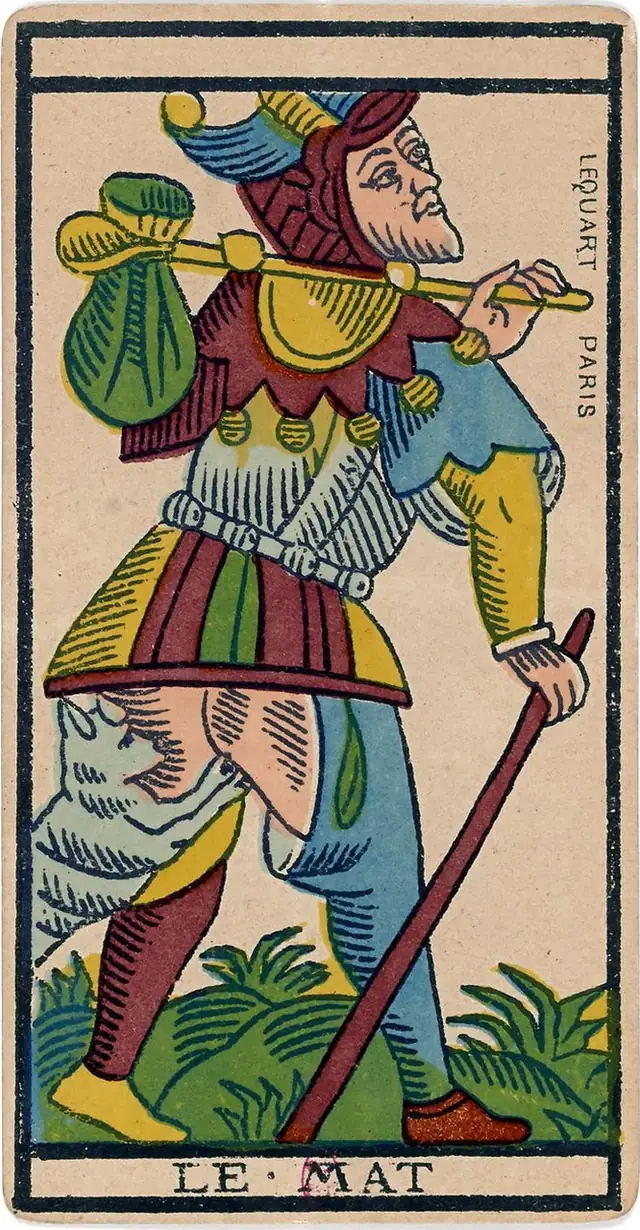
- The Excuse, a single unnumbered card, the descendant of the Fool.
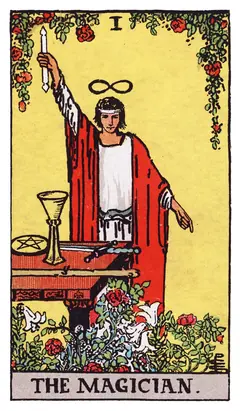
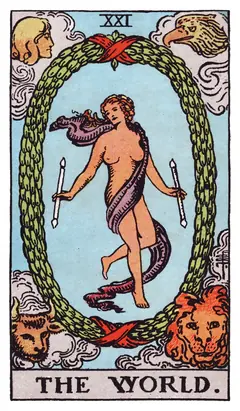
Three cards are special, the bouts or oudlers: the 1 of trumps, called the Petit, the 21 of trumps and the Excuse. In a reading deck the Petit is the place of the Magician and the 21 the place of the World. The more bouts the taker wins, the fewer points they need.
Each card is worth points when you count your tricks: bouts and Kings 4.5, Queens 3.5, Knights 2.5, Jacks 1.5, every other card 0.5. The whole deck adds up to 91.[2]
How to play French Tarot
These are the rules for four players, the standard game. Play goes anticlockwise.[2]
- Deal. The dealer gives 18 cards to each player, three at a time, and sets six cards face down in the middle. These six are the chien, the dog.
- Bid. Starting to the dealer's right, each player bids once or passes. From lowest to highest the bids are Petite (also called Prise), Garde, Garde sans le chien and Garde contre le chien. The highest bidder becomes the taker; the other three play together against them.
- Take the dog. After a Petite or a Garde, the taker shows the six cards of the dog, adds them to their hand and discards six cards face down. Kings and bouts may not be discarded, and trumps only when there is no other choice. In the two higher bids the dog stays unseen: it counts for the taker in a Garde sans, and for the defenders in a Garde contre.
- Announce a handful. A player with ten or more trumps may show them before the first trick for a bonus, called a poignée.
- Play the 18 tricks. The player to the dealer's right leads. You must follow suit. If you cannot, you must play a trump, and if a trump is already on the trick you must play a higher one if you can. Only when you have neither suit nor trumps may you throw any card. The highest trump wins the trick, or the highest card of the suit led if no trump was played.
- Play the Excuse. The Excuse can be played on any trick, whatever you hold. It almost never wins; its owner keeps it and gives a 0.5-point card to the winners instead.
- Count. When all 18 tricks are played, the taker counts the card points in their tricks and checks them against their target.
- Score and pass the deal. The deal moves to the right, and a game usually runs for an agreed number of hands.
How does scoring work in French Tarot?
The taker's target depends on how many bouts they end up with:[2]
- 3 bouts: 36 points.
- 2 bouts: 41 points.
- 1 bout: 51 points.
- No bouts: 56 points.
A hand is worth 25 points plus the amount by which the taker beat or missed the target. That figure is doubled for a Garde, multiplied by four for a Garde sans and by six for a Garde contre. Bonuses come on top: 10 points (also multiplied) for winning the last trick with the Petit, the petit au bout; 20, 30 or 40 for a handful; and 200 or 400 for a slam, winning every trick. Each defender pays the taker the hand's value, or receives it if the taker failed, so the taker wins or loses three times as much.
With five players each gets 15 cards and the dog has three. The taker calls a King, and whoever holds it becomes a secret partner, revealed only when the King is played. With three players each gets 24 cards and the dog stays at six.
Can you play tarot with a reading deck?
Yes. Any 78-card tarot works, as long as you know which card plays which role. The four suits map onto French suits: cups are hearts, pentacles or coins are diamonds, wands are clubs and swords are spades. Pages play as Jacks. The trumps rank by their number, whatever the picture, and the Fool is the Excuse.
Two snags. A Rider–Waite–Smith deck numbers Strength VIII and Justice XI, the reverse of older decks, which makes no difference to play as long as everyone reads the number on the card. And the Minor Arcana pictures can hide the suit sign, so new players should sort their hand by suit before bidding.
Tarot game and tarot reading
The two traditions have lived side by side for 250 years and rarely meet. In France people who play tarot on a Sunday afternoon may never have seen a reading, and readers in Britain and America are often surprised that the game exists. The structure they share explains a lot: the trump suit is the Major Arcana, the court cards with their extra Knight are the reason a tarot suit has 14 cards rather than 13, and the Fool's place outside the numbers matches its old role in the game as the Excuse, the card that excused its owner from following suit.[1] See Major and Minor Arcana and Tarot and playing cards.