
Antoine Court de Gébelin
People · 3 min read · updated
Antoine Court de Gébelin (about 1725–1784) was a French Protestant pastor and scholar who announced, in 1781, that tarot was a book of ancient Egyptian wisdom disguised as a card game. The claim had no evidence behind it, but it is the single most important moment in the history of tarot as something more than a game: fortune-telling with tarot, the links to the Hebrew alphabet and the whole occult tarot tradition all start from his essay.
- Known for
- The Egyptian theory of tarot, 1781
- Main work
- Le Monde primitif, 9 volumes, 1773–1782
- Tarot essay
- Volume 8, 1781
- Co-author
- The Comte de Mellet, on tarot and fortune-telling
- Profession
- Protestant pastor, scholar
- Deck he described
- Tarot de Marseille
Who was Court de Gébelin?
He was the son of Antoine Court, the pastor who rebuilt the Protestant church in southern France after a century of persecution. He was trained for the ministry in Lausanne and served as a pastor before moving to Paris around 1763, where he worked to win legal rights for French Protestants and moved in learned and Masonic circles. He belonged to the Paris lodge Les Neuf Sœurs, whose members included Voltaire and Benjamin Franklin.
His life's project was Le Monde primitif, the Primitive World: a vast study arguing that all languages, myths and symbols came from one lost civilisation. Nine volumes appeared between 1773 and 1782. It made him famous, and it is now read mainly for the twenty pages about cards.
What did he say about tarot?
In volume 8, in 1781, he told how he had come across tarot being played at a friend's house and recognised, within minutes, that its trumps were Egyptian. Tarot was then an ordinary card game in parts of France, Switzerland and Italy, little known in Paris.[1] His claims, all unsupported, were these:
- Tarot was the Book of Thoth, the surviving work of Egyptian priests, hidden in a game so it would outlast the burning of libraries.
- The name came from Egyptian words, tar for road and ro or rog for royal: the royal road of life. No such Egyptian words are known.
- The 22 trumps were allegories of Egyptian religion: the High Priestess was a high priest, the Hanged Man was Prudence drawn upside down by mistake.
- Playing cards in general came from tarot, not the other way round.
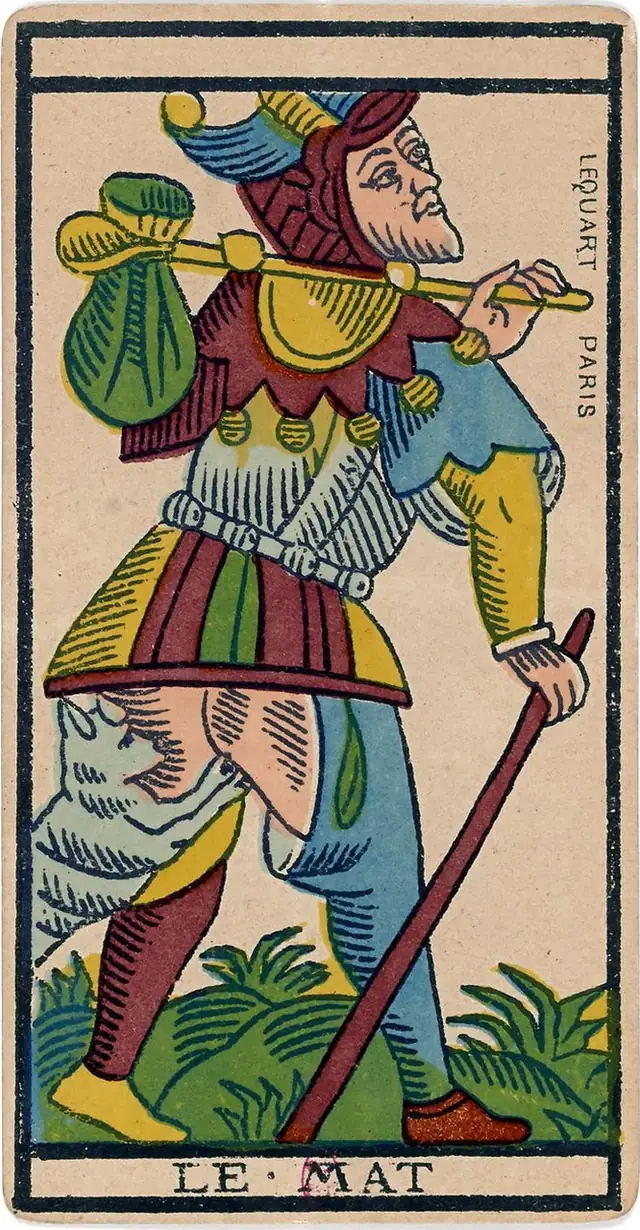
He printed engravings of all 22 trumps and the four Aces from a Marseille-style deck, so for many later readers these were the first tarot pictures they ever saw. He also gave room to an essay by the Comte de Mellet, who linked the trumps to the 22 letters of the Hebrew alphabet and described how the cards were used to tell fortunes.[2] That essay, not Court de Gébelin's own, contains the first known description of tarot divination.
Why did people believe him?
In 1781 no one could read Egyptian hieroglyphs; Champollion deciphered them in 1822. Egypt was a screen on which European writers projected lost wisdom, and a scholar of Court de Gébelin's standing could say almost anything about it. His essay also arrived as the Paris card reader Etteilla was looking for a grander pedigree for his trade, and Etteilla ran with it.[1]
When historians finally checked, the theory fell apart. Tarot appears in Milan and Ferrara around 1440 as a game called trionfi, a century after playing cards reached Europe, and its trumps are Christian and courtly images of the Italian Renaissance. See History of tarot and Myths about tarot's origins.
His legacy
Court de Gébelin died in Paris in 1784, shortly after taking a treatment from the mesmerist Franz Mesmer, whom he had publicly championed; the timing was a gift to Mesmer's critics. His Egyptian tarot lived on. Etteilla built a fortune-telling system on it, Éliphas Lévi built a system of magic on Mellet's Hebrew letters, and the Golden Dawn inherited both. Many decks still carry Egyptian imagery, and the idea of tarot as a secret book begins with him.