
Occult tarot
History · 3 min read · updated
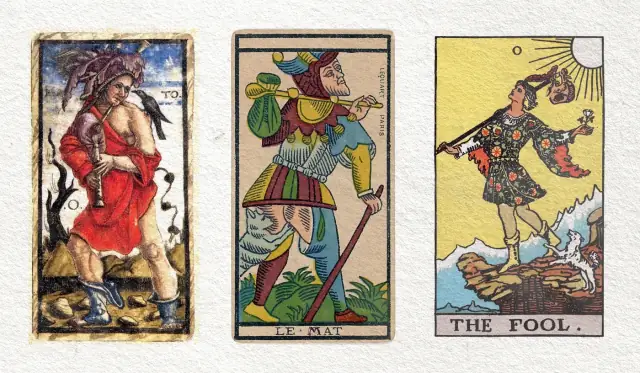
Occult tarot is the idea that the tarot deck holds hidden wisdom, and the tradition of study and magic built on it. It began in Paris in 1781, when Antoine Court de Gébelin declared tarot an ancient Egyptian book, grew through Etteilla's fortune-telling and Éliphas Lévi's Kabbalah, and reached its classic form in the London magical order of the Golden Dawn, whose members made the Rider–Waite–Smith and the Thoth. For the three centuries before that, tarot had been a card game and nothing more.
- Began
- Paris, 1781
- Founding claim
- Tarot is an ancient Egyptian book
- Key figures
- Court de Gébelin, Etteilla, Lévi, Papus, Wirth
- English school
- The Golden Dawn, from 1888
- Best-known decks
- Rider–Waite–Smith, 1909; Thoth, 1969
- Standard history
- Decker, Depaulis and Dummett, 1996 and 2002
Before the occult: a card game
Tarot appeared in northern Italy around 1440 as trionfi, a game of trumps, and spread as a game to France, Switzerland and much of central Europe. People played it for three centuries without any record of mystical meaning, and tarot games are still played in France and Austria today. See History of tarot and Tarot as a card game.
1781: the Egyptian theory
In the eighth volume of his Monde primitif, Antoine Court de Gébelin claimed that tarot was the Book of Thoth, the wisdom of Egyptian priests hidden in a game. The same volume printed an essay by the Comte de Mellet that tied the 22 trumps to the Hebrew alphabet and described fortune-telling with the cards.[1] Every later occult system grows from these two essays.
Etteilla and fortune-telling
The Paris card reader Etteilla seized on the Egyptian idea. From 1783 he wrote books on tarot divination, and around 1789 he published the first deck designed only for reading, with upright and reversed meanings printed on each card. His work made tarot a tool of professional in France.[1]
Lévi and the French occult revival
Éliphas Lévi turned tarot from fortune-telling to high magic. In Dogme et rituel de la haute magie (1854–1856) he made Mellet's link with the Hebrew letters a system and called tarot the key to all occult knowledge. A generation of Paris occultists took him at his word: in 1889 Papus published Le Tarot des Bohémiens, and Oswald Wirth drew the first trumps designed to carry the doctrine.[2]
The Golden Dawn and the English school
The Hermetic Order of the Golden Dawn, founded in London in 1888, built the most complete system of all. It moved the Fool to the head of the trumps, swapped Strength and Justice, and gave every one of the 78 cards a place in astrology and on the . Members copied the order's deck by hand and swore to keep its teaching secret.
Two members made decks that took the system public. A. E. Waite and Pamela Colman Smith published the Rider–Waite–Smith in 1909, and Aleister Crowley and Frieda Harris painted the Thoth between 1938 and 1943. In 1937–1940 Israel Regardie printed the Golden Dawn's papers, and the secret became a library shelf.
From occult to popular
In the 20th century occult tarot moved from lodges to bookshops. Paul Foster Case's Builders of the Adytum taught it by correspondence in America, and from the 1960s the counterculture, cheap printing and new publishers put decks in ordinary shops. Psychological readings drawing on Carl Jung joined the occult ones, and most readers today mix the two without thinking of where each came from.[3] See Modern tarot decks.
Is occult tarot historical?
Its claims about the past are not. There is no Egyptian, Hebrew or Romani source behind the cards, and the Kabbalistic links were made in Paris and London long after the deck existed.[1] Its systems are real, though, and they are historical facts in their own right: the symbols on most decks a reader buys today were put there by occultists, so knowing their ideas helps to read the pictures. See Myths about tarot's origins.
Timeline
- About 1440: tarot appears in Italy as a card game.
- 1781: Court de Gébelin and Mellet: tarot is Egyptian and Hebrew.
- 1783–1789: Etteilla's books and deck for divination.
- 1854–1856: Lévi's Dogme et rituel de la haute magie.
- 1888: the Golden Dawn is founded in London.
- 1889: Papus's Tarot des Bohémiens and Wirth's trumps.
- 1909: the Rider–Waite–Smith.
- 1937–1940: Regardie publishes the Golden Dawn's teachings.
- 1969: the Thoth tarot is published.