
Modern tarot decks
Decks · 3 min read · updated
A modern tarot deck, in the sense most people mean, is one built on the Rider–Waite–Smith of 1909: 78 cards, with a picture on every card, including the numbered ones. For half a century there were only a handful of such decks. From the late 1960s new publishers, the counterculture and later the internet turned tarot design into a genre of its own, and today thousands of decks are in print, most of them following Pamela Colman Smith's scenes.
- Model for most decks
- Rider–Waite–Smith, 1909
- Main alternative
- Thoth, painted 1938–1943, printed 1969
- Boom began
- Late 1960s and 1970s
- Since the 2010s
- Indie, crowdfunded and self-published decks
- Smith's art
- Public domain in the UK and EU since 2022
- Decks in print
- Thousands
The two parents: Rider–Waite–Smith and Thoth
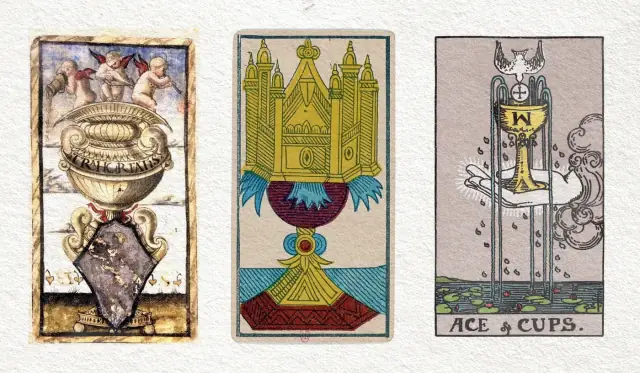
Almost every modern deck descends from one of two. The Waite–Smith deck of 1909 gave each of the 56 cards its own scene, so a beginner could read the Five of Cups from its picture rather than counting cups. The Thoth, painted by Frieda Harris for Aleister Crowley, went the other way: abstract, geometric numbered cards and a dense system of astrology and Kabbalah. Decks that follow Waite–Smith are called RWS clones or RWS-based; decks that follow Crowley are called Thoth-based.
A third family, the Tarot de Marseille, keeps the older style, with pictures only on the trumps and courts. It is still the standard in France and parts of Latin America.
1910–1960: a small field
For decades new decks were rare and mostly came from occult groups. Paul Foster Case's Builders of the Adytum in Los Angeles issued a deck to colour in by hand, based on Waite–Smith with Case's corrections; the Church of Light and other American schools made their own. In Europe the Marseille and Etteilla decks went on being printed for card readers. The Rider–Waite–Smith itself was hard to buy outside Britain.[1]
The 1970s boom
In 1968 Stuart Kaplan founded U.S. Games Systems in New York, and from 1971 it distributed the Rider–Waite–Smith in America, where it became the beginner's deck. The Thoth appeared in colour in 1969. The counterculture's interest in astrology and the occult, cheap colour printing and a market for books on tarot did the rest. New decks of the period include the Aquarian Tarot (1970), with Art Nouveau figures by David Palladini.[2]
Decks with a point of view
From the late 1970s artists began making decks that rethought tarot from a perspective, not just a style. The Motherpeace Tarot (1981) by Vicki Noble and Karen Vogel had round cards and women of many cultures; it started a wave of feminist and goddess decks. Others reworked tarot through Greek myth, Arthurian legend, Norse, Native American or Japanese imagery, or through particular readers' lives, and from the 2010s, a growing number of decks set out to show bodies, skin colours and relationships the old cards left out.
Indie decks and the internet
Since about 2010 the biggest change has been who makes decks. Print-on-demand, crowdfunding sites and social media let any artist publish a tarot, and many of the best-selling decks of the last fifteen years began as small runs by independent illustrators. Most of them keep the Waite–Smith scenes underneath, which is why a reader who learns on one deck can usually read another. See How to choose a tarot deck.
Is the Rider–Waite–Smith in the public domain?
Mostly, yes. The 1909 deck is in the public domain in the United States because of its age, and Smith died in 1951, so under the life-plus-70-years rule her art entered the public domain in the UK and the EU on 1 January 2022. Later recoloured editions and the names of particular branded editions can still be protected, so the old images are free to use while a specific modern printing may not be.
Tarot or oracle?
Many modern decks sold beside tarot are not tarot at all but , with any number of cards and no fixed structure. A deck is tarot if it has 78 cards in the classic structure of 22 trumps and four suits of 14. See Tarot vs oracle cards.