How to choose a tarot deck
Reading tarot · 2 min read · updated
For a first deck most readers recommend the Rider–Waite–Smith or a modern deck built on it, because every card shows a scene you can read from the picture and almost every book uses its meanings. After that, choose by what you want to look at every day: art, size and card stock matter more than tradition.
- Best first deck
- Rider–Waite–Smith or a deck based on it
- Three traditions
- Rider–Waite–Smith, Marseille, Thoth
- Check
- 78 cards, illustrated numbered cards, readable size
- Gift rule
- A modern custom; buying your own is fine
The three traditions
Almost every deck on sale follows one of three traditions.
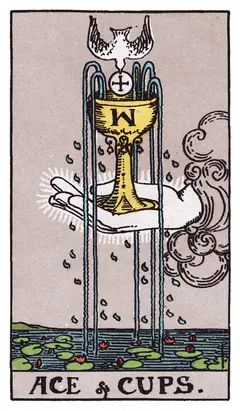
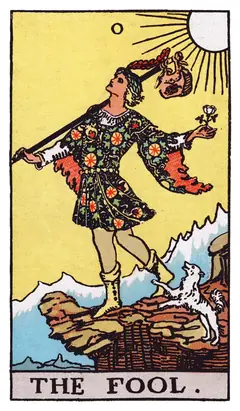
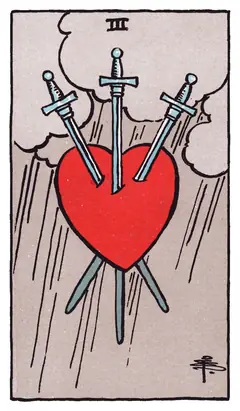
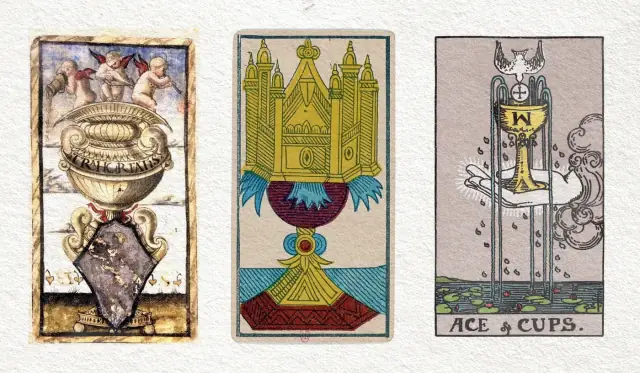
- Rider–Waite–Smith (1909). Every card, numbered ones included, is a scene with people. Most modern decks and books follow it. It is by far the most used deck in the English-speaking world, with more than 100 million copies in circulation by one museum's count.[1]
- Tarot de Marseille (from the 17th century). Bold woodcut and courts; the numbered cards show only arranged suit signs. Popular in France, Italy and Latin America, and with readers who like to read number and suit.
- Thoth (painted 1938–1943). Aleister Crowley and Frieda Harris's dense, astrological deck. Rich and demanding, with its own names for several cards.[2]
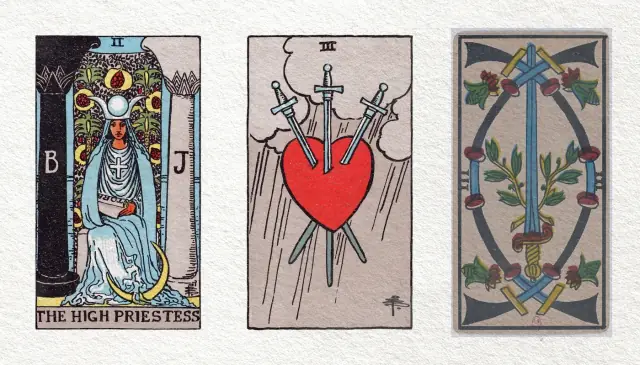
What to check in a first deck
- Illustrated numbered cards. If the Five of Cups shows a person mourning, you can read it before you learn it. Pip-only decks are harder to start with.
- Standard names and order. A deck that renames cards or changes the structure makes books and websites harder to use.
- 78 cards. Some products sold as tarot are oracle decks. See Tarot vs oracle cards.
- Size and stock. Standard tarot cards are about 7 × 12 cm. Smaller hands may prefer a mini edition; thin, glossy stock slips when shuffled.
- Art you want to look at. You will look at these pictures daily. Diverse figures, a style you like, a palette that does not tire you.
- A guidebook. A booklet with each card's meaning helps; a good book helps more.
The gift myth
You may hear that your first deck must be given to you. We know of no historical source for it; it is a modern custom that spread with popular tarot books and the internet. Buy the deck you like.
Classic, clone or new?
Many modern decks redraw the Rider–Waite–Smith scenes in a new style, so they keep its meanings while changing the look. These are the easiest second decks. Fully original decks with new symbolism are better once you know the system.
Pulp includes three historical decks to compare: the Rider–Waite–Smith, a Marseille-pattern deck from about 1890 and the Sola Busca of 1491. Looking at one card in all three, as above, is the quickest way to see which style speaks to you.