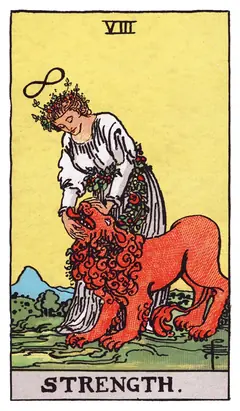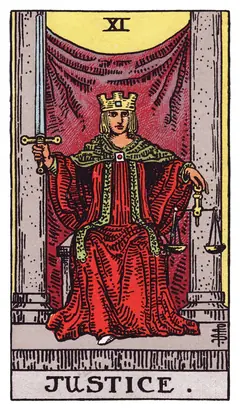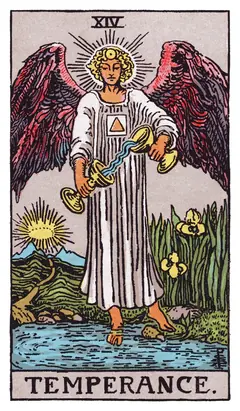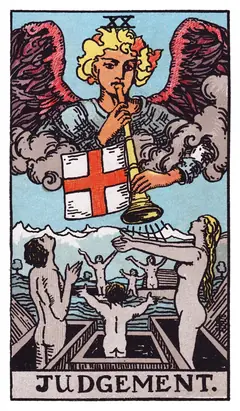
Thoth tarot
Decks · 2 min read · updated
The Thoth tarot is a 78-card deck designed by the occultist Aleister Crowley and painted by the artist Frieda Harris between 1938 and 1943. Dense with astrological and Kabbalistic symbols, it renames several cards and the court ranks, and it is the third great tradition beside the Rider–Waite–Smith and the Tarot de Marseille.
- Designed by
- Aleister Crowley
- Painted by
- Frieda Harris
- Painted
- 1938–1943
- Book
- The Book of Thoth, 1944
- First printed as a deck
- 1969
- System
- Golden Dawn correspondences, Thelema
- Courts
- Princess, Prince, Queen, Knight
- Originals
- Warburg Institute, London
How it was made
Aleister Crowley (1875–1947) had been a member of the Golden Dawn, the same order as Waite and Pamela Colman Smith, before founding his own religious movement, Thelema. In 1937 he was introduced to the painter Frieda Harris (1877–1962), who became his student and the deck's artist. What Crowley planned as a few months' work lasted five years: Harris painted and repainted the 78 cards from 1938 to 1943, often several versions of one card.[1] See Frieda Harris.
Crowley published his explanation of the deck, The Book of Thoth, in 1944, in a small signed edition.[2] Neither he nor Harris saw the cards printed as a deck. Crowley died in 1947, Harris in 1962. The first printed deck appeared in 1969, photographed from the paintings, and later editions improved the colour.[1] The original paintings are held by the Warburg Institute in London.
How it differs from the Rider–Waite–Smith
The structure is the same 78 cards, but much else changes.
Renamed .[2]
- VIII Adjustment instead of Justice.
- XI Lust instead of Strength: not strength over a beast, but joy in it.
- XIV Art instead of Temperance.
- XX The Aeon instead of Judgement: a new age rather than the Last Judgement.
- XXI The Universe instead of The World.
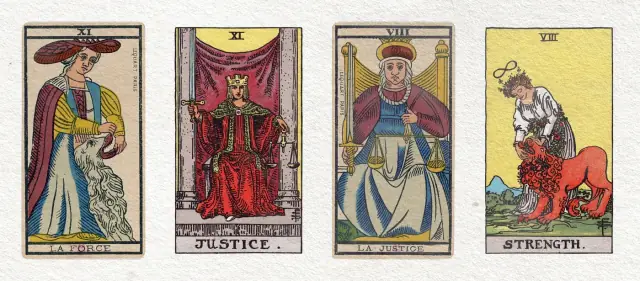
Like the Golden Dawn and Waite, Thoth puts Justice's card at VIII and Strength's at XI, against the older order of the Tarot de Marseille. See Why Strength is 8 and Justice 11.
Court cards. Princess, Prince, Queen and Knight. The mounted Knight is the highest rank and the Prince stands where the King would be, following the Golden Dawn system.[1] See Court cards.
Suits. Wands, Cups, Swords and Disks (instead of Pentacles).
Numbered cards. No scenes with people, as in the Rider–Waite–Smith, but abstract compositions of the suit signs, each with a one-word title: the Three of Swords is "Sorrow", the Ten of Cups "Satiety". Each also carries its planet and zodiac sign.
Symbolism. Every card is built from the Golden Dawn's tables of correspondences, Egyptian imagery and Crowley's own Thelema. See Tarot and astrology and Tarot and the Kabbalah.
Is Thoth good for beginners?
It is harder than the Rider–Waite–Smith. The numbered cards have no scenes, several names differ from most books, and the full meaning depends on astrology and Kabbalah. Readers who like it praise exactly that density and Harris's painting. A common path is to learn on a Rider–Waite–Smith deck and add Thoth later. See How to choose a tarot deck.
Why Pulp does not include it
Frieda Harris died in 1962, so her paintings are still protected by copyright in most countries until the end of 2032. Pulp uses only public-domain decks, the Rider–Waite–Smith, a Marseille-pattern deck and the Sola Busca, so this page describes the Thoth deck rather than reproducing it.