Rider–Waite–Smith vs Marseille
Decks · 4 min read · updated
The biggest difference between the Rider–Waite–Smith and the Tarot de Marseille is the numbered cards: the Rider–Waite–Smith, published in London in 1909, shows a scene with people on every card, while the Marseille, a French pattern from the 17th century, shows only an arrangement of suit signs. The two also differ in several card names, in the numbers of Strength and Justice, and in how readers use them.
- Rider–Waite–Smith
- London, 1909
- Tarot de Marseille
- France, from c. 1650
- Numbered cards
- RWS: scenes. Marseille: suit signs
- Strength and Justice
- RWS: VIII and XI. Marseille: XI and VIII
- Most used in
- RWS: English-speaking world. Marseille: France, Italy, Spain, Latin America
Quick comparison
- Age. Marseille: a printed pattern of French card-makers, the oldest surviving example around 1650. Rider–Waite–Smith: designed in 1909.
- Makers. Marseille: generations of anonymous woodcutters and named printers. RWS: the writer Arthur Edward Waite and the artist Pamela Colman Smith.
- Numbered cards. Marseille: suit signs only, sometimes with flowers and vines. RWS: a scene on every card.
- Symbolism. Marseille: older, simpler, with no occult system built in. RWS: shaped by the Golden Dawn's correspondences.
- Card names. Marseille: French titles, Death without a name, the Fool without a number. RWS: English titles, every card named and numbered.
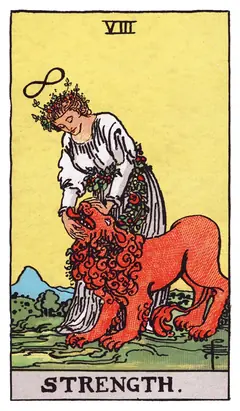
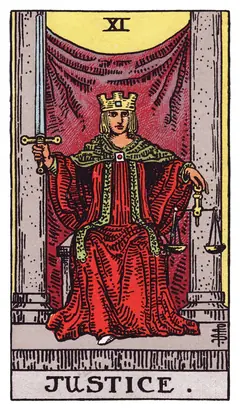
- Order. Marseille: Justice VIII, Strength XI. RWS: Strength VIII, Justice XI.
Where each deck comes from
The Tarot de Marseille is not one deck but a pattern, the standard design French card-makers copied from one another for two centuries. The oldest surviving example was printed by Jean Noblet in Paris around 1650; others followed in Lyon and in Marseille, where Nicolas Conver published a famous edition in 1760.[1] It was a deck for the game, and it was the deck the first occultists in Paris used in the 1780s. The name itself is later: it became fixed in the 20th century, largely through a Grimaud edition of 1930.
The Rider–Waite–Smith was designed for reading. Arthur Edward Waite, a member of the Golden Dawn, planned it and commissioned Pamela Colman Smith to draw all 78 cards; William Rider & Son published it in London in December 1909, and Waite's guide followed.[2] Its American reissue by U.S. Games Systems in 1971 made it the most widely used tarot in the English-speaking world.[3] See the Rider–Waite–Smith deck page and the Tarot de Marseille deck page.
How are the Minor Arcana different?
This is the difference you see first. On a Marseille deck the Two to Ten of each suit are , like an ordinary playing card: seven cups or nine coins arranged in a pattern, with flowers in between. On the Rider–Waite–Smith each of those 36 cards is a little scene. A man walks away from eight cups, three people raise their cups, a figure carries ten heavy wands.
So the two decks are read in different ways. With the Rider–Waite–Smith you can describe what you see and start from there, which is why beginners find it easy. With the Marseille the are read from the number and the suit: what Five means, what Cups mean, how the signs are arranged. Readers who use it say it leaves more room; readers who do not say it gives less to go on. See Numbers in tarot.
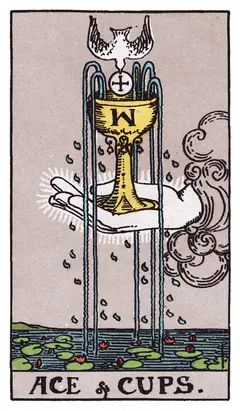
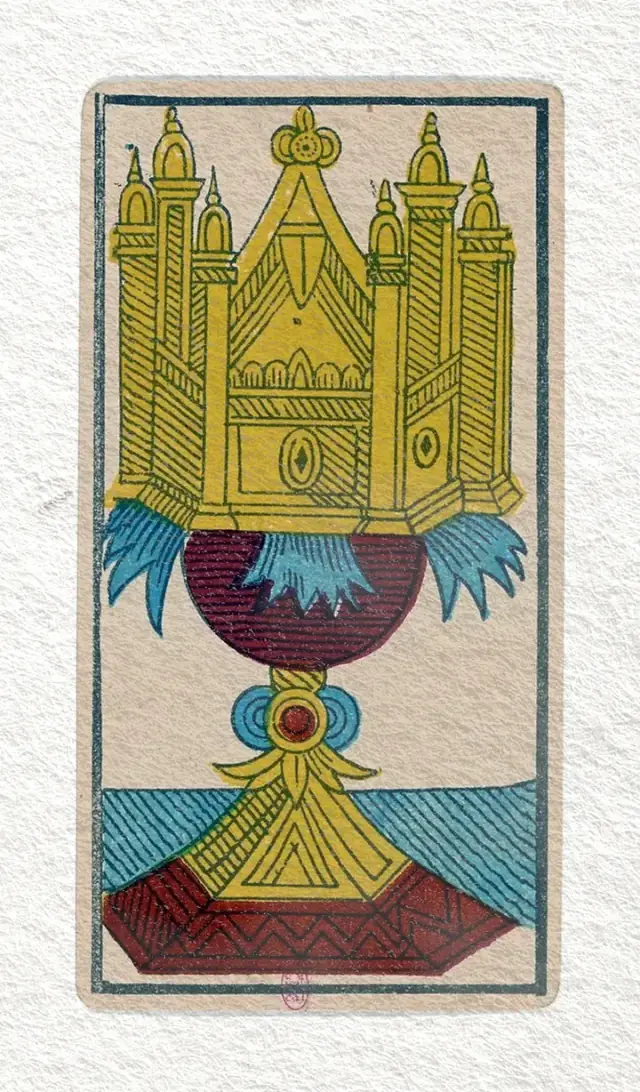
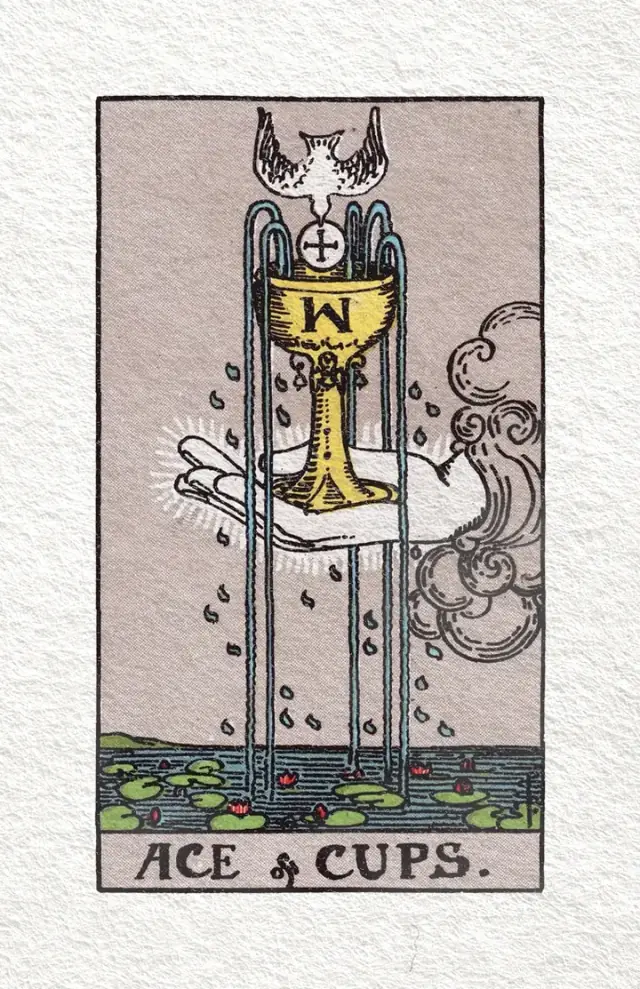
The aces and the are pictures in both decks, as the Ace of Cups shows, though the Marseille courts are bolder and plainer.
Are the Major Arcana the same?
Mostly. The 22 trumps have the same subjects in the same order, with a few changes of name and one change of number.[2]
- Le Bateleur, the juggler or street conjurer, becomes the Magician.
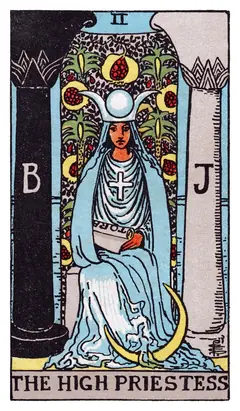
- La Papesse, the female pope, becomes the High Priestess, and Le Pape becomes the Hierophant.
- L'Amoureux shows a young man between two women under Cupid; Smith's Lovers are Adam and Eve under an angel.
- XIII has no name on Marseille decks; it is Death on the Rider–Waite–Smith.
- La Maison Dieu, literally God's house, becomes the Tower.
- Le Mat has no number on Marseille decks; the Fool is 0 on the Rider–Waite–Smith.
The number change is the one that trips people up. On Marseille decks Justice is VIII and Strength is XI. The Golden Dawn swapped them so that the cards would fit its zodiac order, and Waite printed the swap on his deck, noting only that he had his own reasons.[2] Both orders are in use, and neither is wrong. See Why Strength is 8 and Justice 11.
Do the suits and courts have the same names?
The suits are the same four with different words. Marseille Bâtons are Wands, Coupes are Cups, Épées are Swords, and Deniers, coins, are the RWS Pentacles: Waite turned the coin into a disc with a five-pointed star, an occult sign. The courts are Valet, Cavalier, Reine and Roi, the RWS Page, Knight, Queen and King. See Tarot suits.
Which is better for beginners?
For most people learning from English books and websites, the Rider–Waite–Smith, because nearly all of them are written for it and its scenes give you something to say about every card. The Marseille suits people who like history, plain design and a system built on numbers, and it is the usual deck in France and much of southern Europe. Plenty of readers keep both. Pulp uses both, along with the Sola Busca.
If you know one deck, the other is not a new language. The Major Arcana carry over almost directly. The Minor Arcana are where you need a new habit: reading number and suit on a Marseille deck, or reading the scene on a Rider–Waite–Smith. See How to choose a tarot deck.