Aleister Crowley
People · 3 min read · updated
Aleister Crowley (1875–1947) was an English occultist who designed the Thoth tarot, painted to his instructions by Frieda Harris between 1938 and 1943, and wrote its guide, The Book of Thoth, in 1944. A former member of the Golden Dawn and the founder of a new religion, Thelema, he built the deck on the Golden Dawn's system of correspondences and on his own beliefs.
- Born
- Edward Alexander Crowley, 1875
- Known for
- Thoth tarot, with Frieda Harris
- Golden Dawn
- Initiated 18 November 1898
- Founded
- Tarot book
- The Book of Thoth, 1944
- Deck first printed
- 1969, after his death
Who was Aleister Crowley?
Crowley was born Edward Alexander Crowley into a wealthy family of brewers in Warwickshire, raised in a strict Christian sect, the Plymouth Brethren, and rebelled against it for the rest of his life. At Trinity College, Cambridge, he wrote poetry and climbed; he later joined expeditions to K2 in 1902 and Kanchenjunga in 1905. He renamed himself Aleister while still a student.[1]
He is remembered mostly as a magician and a provocateur. He practised and wrote about ceremonial magic, used drugs openly, wrote frankly about sex, and enjoyed his own scandal; in the 1920s the British press called him the wickedest man in the world. Historians of religion now treat him as one of the most influential figures in modern Western occultism, whatever they think of the man.[1]
Crowley and the Golden Dawn
Crowley was initiated into the Hermetic Order of the Golden Dawn in London on 18 November 1898. There he learned its teaching: every card tied to a Hebrew letter, a planet, a sign of the zodiac or an element, laid out in the order's private text on the cards, .[2] In the quarrels of 1900 he took the side of the order's leader, Samuel Liddell MacGregor Mathers, against the London members; within a few years he had broken with Mathers too.
From 1909 Crowley printed Golden Dawn rituals in his own journal, The Equinox, breaking the order's oath of secrecy. Mathers went to court to stop him and lost. In the same year Crowley published 777, a book of tables of that put the order's tarot system in front of anyone who bought it.[2] See The Golden Dawn.
What is Thelema?
, from the Greek for "will", is the religion Crowley founded. He said that in Cairo, in April 1904, a voice dictated to him over three days a short text he called The Book of the Law. Its central teaching is that each person should find and follow their true will. Crowley believed it opened a new age, which he called the Aeon of Horus.[1]
He spent the rest of his life spreading it: through his own order, the A∴A∴, from 1907; as head of the Ordo Templi Orientis; and at the Abbey of Thelema, a commune in Cefalù, Sicily, from which Mussolini's government expelled him in 1923. Thelema matters for tarot because it is written into the Thoth deck.
How did Crowley make the Thoth tarot?
Crowley had wanted his own tarot for years. In 1937 he met the painter Frieda Harris, wife of a Liberal member of parliament, who became his student and offered to paint it. He planned a few months' work. It took five: from 1938 to 1943 Harris painted all 78 cards, often several versions of one card, as Crowley revised his instructions.[2]
Crowley published the explanation, The Book of Thoth, in 1944, in a small signed edition.[3] Neither of them saw the deck printed. Crowley died at a boarding house in Hastings in 1947, and the first printed deck, photographed from Harris's paintings, came out in 1969.[2] See Thoth tarot and Frieda Harris.
What did Crowley change in tarot?
He kept the 78 cards and their structure and changed a good deal of the surface:[3]
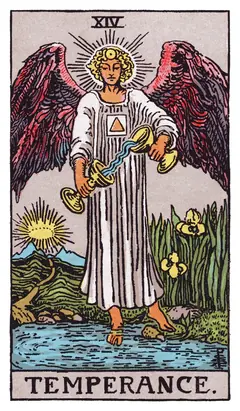
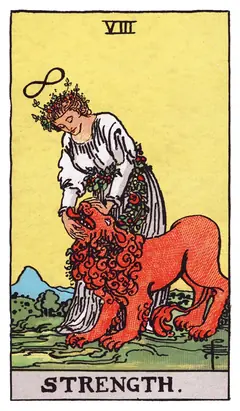
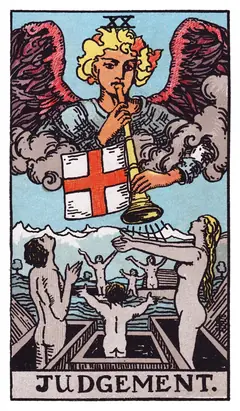
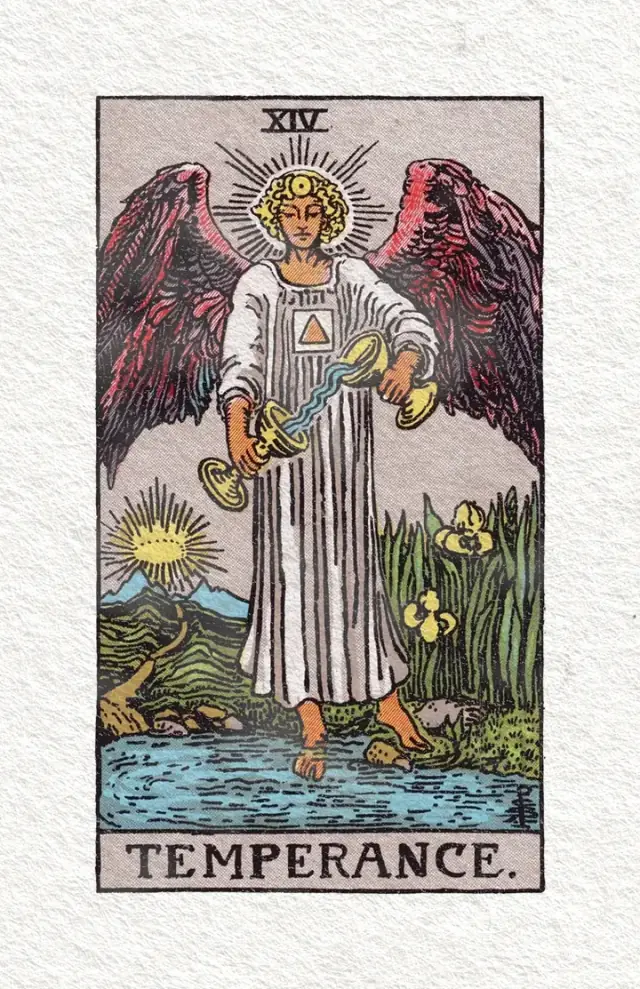
- Renamed trumps. Temperance becomes Art, Strength becomes Lust, Justice becomes Adjustment, and Judgement becomes the Aeon, the card of his new age.
- Old numbers back. Unlike the Golden Dawn and Waite, he put Adjustment at VIII and Lust at XI, the order of the old decks, while keeping the Golden Dawn's zodiac signs on them.
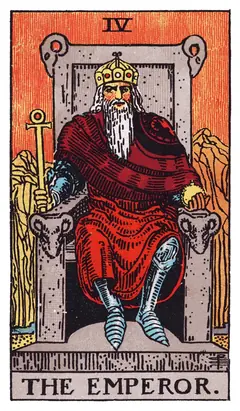
- One letter swap. Following a line in The Book of the Law, he exchanged the Hebrew letters of the Emperor and the Star.
- New courts and suit. Knight, Queen, Prince and Princess, and Disks in place of Pentacles.
- Titled numbered cards. Abstract designs of the suit signs, each with a one-word title and its planet and sign.
Where the Rider–Waite–Smith keeps much of the Golden Dawn system out of sight, the Thoth deck puts it on the surface of every card. That density is why some readers love it and others find it hard.
Crowley and Waite
The two great English tarots of the 20th century were made by men who disliked each other. Arthur Edward Waite was a Christian mystic who wrote cautiously and kept the order's secrets; Crowley mocked him in The Equinox and published those secrets. Both started from the same Golden Dawn lessons, and the difference between their decks follows from the difference between them. See Rider–Waite–Smith vs Marseille for the older tradition both drew on.