Tarot vs oracle cards
Tarot basics · 2 min read · updated
A tarot deck always has the same 78-card structure, 22 and 56 cards in four suits, so a card keeps broadly the same meaning from one deck to the next. An oracle deck has no fixed structure: any number of cards, any themes, meanings set by its author.
- Tarot cards
- 78, always
- Oracle cards
- Any number, often 36 to 60
- Tarot structure
- 22 trumps and 4 suits
- Oracle structure
- Set by each author
- Tarot meanings
- Shared across decks
- Oracle meanings
- In the deck's own booklet
- Oldest named oracle
- Lenormand, 36 cards, from a 1799 game
The short difference
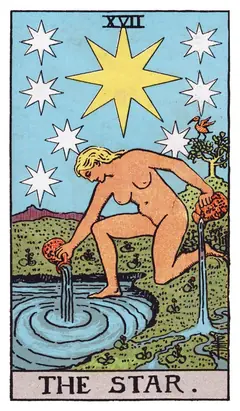
Tarot is a system. Every tarot deck, from a hand-painted Renaissance pack to an app, has 22 Major Arcana and four suits of 14 cards. The art changes, the skeleton does not. That is why a reader who knows one deck can read another, and why The Star means hope in nearly every deck.
An oracle deck is a single author's work. It can have 36 cards or 60, angels or animals or affirmations, and the meaning of each card is whatever its booklet says. Two oracle decks have nothing in common unless their authors agreed.
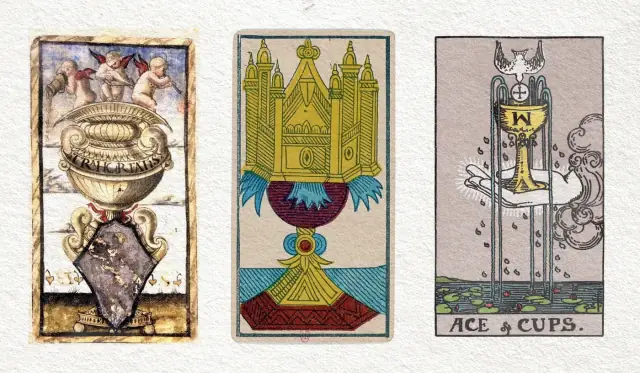
Side by side
- Number of cards: tarot 78; oracle any.
- Structure: tarot has , suits, numbers and court cards; oracle has none unless the author adds them.
- Meanings: tarot meanings are shared and documented over two centuries; oracle meanings live in one booklet.
- Reading: tarot readings use positions, suits and numbers; oracle readings usually read one card or a few as messages.
- Origin: tarot began as an Italian card game around 1440 and was used for from about 1750;[1] oracle decks come from 19th-century fortune-telling packs and became a large genre from the 1990s.
Where oracle cards come from
The best-known old oracle is the Lenormand deck: 36 small cards with pictures such as the ship, the house and the clover. It comes from a German parlour game published around 1799, Das Spiel der Hoffnung, and was later sold under the name of the famous Parisian fortune-teller Marie Anne Lenormand, who died in 1843 and had nothing to do with it.[2]
Tarot was turned into a fortune-telling tool in the same period, in Paris in the 1780s.[3] The two traditions grew side by side, but tarot kept its old structure while oracle decks were free to invent.
Which to start with
Start with tarot if you want a language that grows with you: once you know the structure, every new deck is readable, and there are centuries of writing to learn from. Start with an oracle deck if you want something gentle and immediate, with no system to learn.
Many readers use both: a tarot spread for the question and one oracle card on top as a theme. Pulp works with tarot because its structure makes patterns visible in a journal: you can see that Cups keep coming up, or that the same card returns every Monday.