Celtic Cross spread
Reading tarot · 6 min read · updated
The Celtic Cross is a ten-card tarot spread: six cards in a cross around the question and four in a column beside it. In order, the positions are the present situation, what crosses it, the aim, the foundation, the recent past, the near future, yourself, your surroundings, hopes and fears, and the outcome. A. E. Waite published it in 1911, and it is still the best-known long spread.
- Cards
- 10, plus an optional significator
- Shape
- A cross of six and a staff of four
- First published
- Waite, 1911, in his Pictorial Key
- Best for
- One definite question, looked at in depth
- Time
- 20 to 45 minutes
- Variants
- Many; the order of cards 3 to 6 differs most
What is the Celtic Cross spread?
A is a fixed layout in which each gives a card a job. The is the classic long one. It looks at a single question from several sides at once: what is going on, what stands in the way, what lies underneath, where things came from and where they are heading, and how you yourself fit in.
A. E. Waite printed it in The Pictorial Key to the Tarot, the companion book to the Rider–Waite–Smith deck, as "an ancient Celtic method of divination". He said it had been used privately for many years in England, Scotland and Ireland and had not been published before.[1] No earlier printed version has been found, and nothing ties it to the ancient Celts; the name is Waite's. He recommended it as "the most suitable for obtaining an answer to a definite question".[1]
How many cards are in a Celtic Cross?
Ten. Waite also placed an eleventh card face up underneath the first, the , chosen before shuffling to stand for the person or matter asked about. Most modern readers leave the significator out and read ten cards drawn from the full deck.
The Celtic Cross positions, step by step
Shuffle, cut, and lay the cards out in this order. The position names are Waite's, with his phrases for the first six; the plain descriptions are how most readers use them today.[1]
- The present. Laid in the centre. Waite's words: "This covers him." The situation as it stands, the atmosphere the rest of the reading works in.
- What crosses you. Laid sideways across card 1: "This crosses him." The obstacle or the force pulling against the first card. Read it upright whichever way it lands. Waite noted that a pleasant card here can mean the obstacle is small, or that something good is not helping in this case.
- The crown. Above the centre: "This crowns him." Your aim, or the best that can be reached, which has not happened yet.
- The foundation. Below the centre: "This is beneath him." The basis of the matter, what is already real and settled.
- The recent past. To one side: "This is behind him." An influence that is passing or has just passed.
- The near future. To the other side: "This is before him." What is coming into play soon.
- Yourself. The bottom of a column of four on the right. Your position and attitude in the matter.
- Your house. Your surroundings: home, friends, work, the people and pressures around the question.
- Hopes and fears. What you want or dread, often the same thing seen from two sides.
- The outcome. The top of the column. Where things are heading if nothing changes, the sum of the other nine cards.
The first six cards make the cross; the last four are often called the staff or the pillar. In Waite's diagram card 7 is at the bottom of the staff and card 10 at the top.
Which side do the past and future go on?
In Waite's version, card 5 goes behind the significator and card 6 in front of it, so the sides depend on which way the figure on the significator card is looking. His own diagram has the figure facing left, which puts the past on the right and the future on the left. For a card that faces neither way, he says, decide before you begin.
Most modern books drop this rule and fix the past on the left and the future on the right, reading like a line of text. Either is fine; choose one and keep to it.
Common variants of the Celtic Cross
Because the layout travelled by word of mouth and through many books, there is no single version. The common changes:
- A different order for cards 3 to 6. Many modern books, Joan Bunning's among them, lay card 3 below (the root or foundation), card 4 to the left (the past), card 5 above (the possible outcome or conscious aim) and card 6 to the right (the near future). The meanings are the same set; only the numbering moves.[2]
- Card 1 as you, card 2 as the challenge. Some readers make the centre card the querent rather than the situation, which removes the need for a significator.
- Conscious and unconscious. The crown and the foundation are often read as what you think about the question and what drives it from below.
- The staff on the left, or laid top to bottom. Some readers put the column on the left of the cross, or start it at the top.
- Advice instead of self. Card 7 is sometimes read as advice: what you can do.
- No outcome card. Readers wary of forecasts rename card 10 the likely direction, or the lesson.
How to choose a significator
If you want to use one, Waite's rules are worth knowing, if only as history. He chose a court card by age and sex, and by colouring: Wands for very fair people, Cups for light brown hair, Swords for dark brown hair and hazel or grey eyes, Pentacles for very dark hair and eyes. He allowed temperament to override looks. Oddly, his book gives the Knight to a man over forty and the King to a younger man, the reverse of what most readers expect.[1]
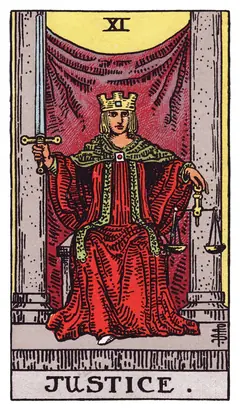
He also allowed a card for the matter instead of the person: to ask whether a lawsuit would be needed, use Justice, the card of legal affairs. Today most readers who use a significator simply pick the they feel most like, or skip it.
How to read a Celtic Cross
Read card by card first, then read the pairs. The spread is built in pairs, and they carry most of the story:
- 1 and 2: the situation and the thing crossing it. This pair is the heart of the reading.
- 3 and 4: what you aim for against what the matter rests on. A gap between them is worth naming.
- 5 and 6: the line of time, from what is leaving to what is arriving.
- 7 and 8: you against your surroundings. Is the pressure inside or outside?
- 9 and 10: what you hope or fear against where things are going. Fears that the outcome does not confirm are often the most useful thing in the spread.
Then look at the whole. Many suggest a large turn in life; many cards of one point to one area. Compare the outcome with the crown: are they the same thing? Waite advised giving the tenth card the most attention, and if it is unclear, laying the spread again with card 10 as the new significator. If card 10 is a court card, he read it as a person in whose hands the matter ends up.[1]
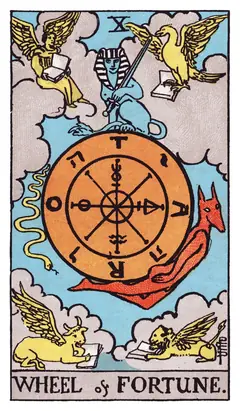
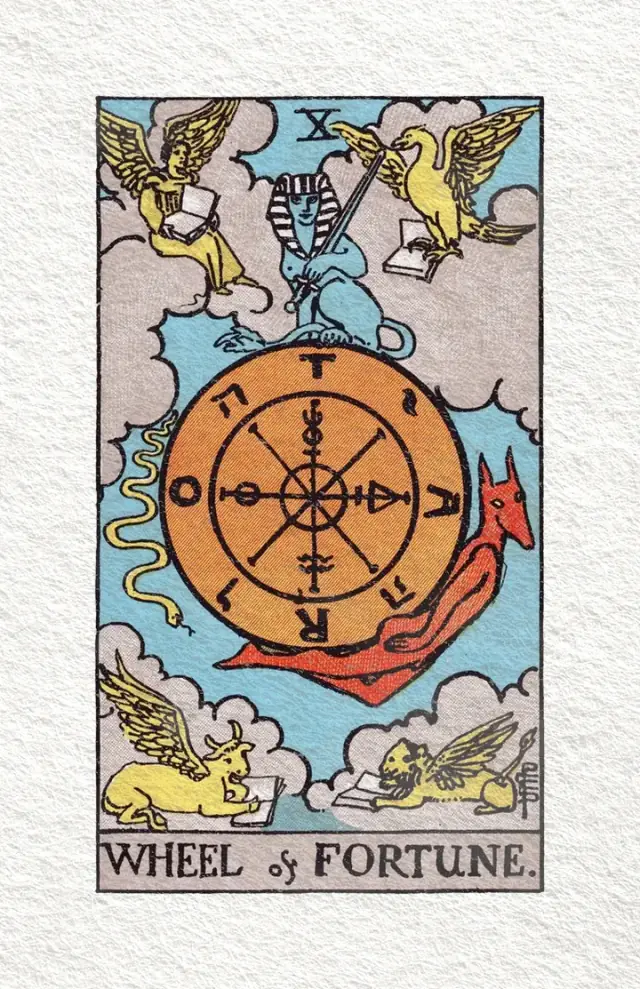
A card like Wheel of Fortune in the outcome reads differently from the same card in the past. The position changes the question the card answers, which is the whole point of a spread.
Is the Celtic Cross good for beginners?
It is a good second spread. Ten cards and ten positions are a lot to hold at once, and beginners often read each card separately and lose the story. Start with one card a day and a three-card spread until the cards feel familiar, then try the Celtic Cross on a question that deserves the time. Write the whole layout down; it is much easier to read a week later. See How to read tarot and Tarot journal.