Three-card spread
Reading tarot · 4 min read · updated
A three-card tarot spread is three cards laid in a row, each with its own position: most often past, present and future, read left to right. It is the most used spread after the single card, quick enough for a busy morning and large enough to tell a small story.
- Cards
- Three
- Classic positions
- Past, present, future
- Layout
- A row, read left to right
- Time
- 5 to 15 minutes
- Best for
- Most everyday questions
- Key card
- The middle one
What is a three-card spread?
A gives each card a job, called its . The three-card spread has three: you decide what they mean before you draw, lay the cards in a row, and read each card in the light of its position. Change the positions and the same three cards answer a different question.
It has no single inventor and no fixed form. The ten-card Celtic Cross goes back to one book, printed by A. E. Waite in 1911.[1] The three-card layout is a format rather than a text, and every reader and book has its own versions.
How to do a three-card tarot reading
- Write down your question. See How to ask tarot a question.
- Choose the three positions, for example past, present, future.
- Shuffle and cut. See How to shuffle tarot cards.
- Lay three cards face down from left to right: 1, 2, 3.
- Turn them one at a time and read each against its position.
- Read the three together: what changes from left to right?
- Write down the cards and one sentence that sums up the reading.
Past, present, future: how to read it
The classic version reads time from left to right:
- Past: what led here. Not your whole history, only what bears on the question.
- Present: where things stand. This is the card the other two lean on.
- Future: where things are heading if nothing changes. Not a fixed fate; a direction.
Set a time frame before you draw, such as the last six months and the next three. Without one, the past card can stretch to childhood and the future card to old age, and the reading loses its edge.
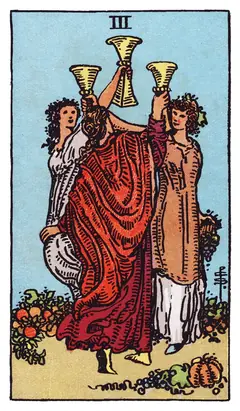
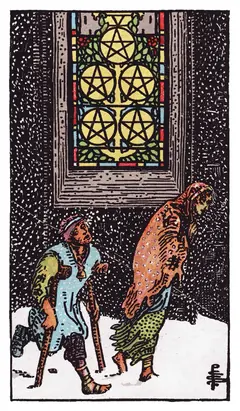
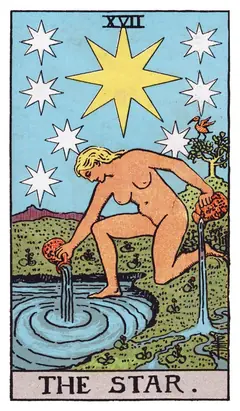
An example: the Three of Cups, the Five of Pentacles, the Star. Read as a line, that is a good time with friends, then a hard, lonely stretch, then hope coming back. The story is in the change from card to card, not in any one of them.
Other three-card tarot spreads
Past, present, future is a starting point. Nine other common layouts, each read left to right:
- Situation, obstacle, advice. The most useful all-round spread: what is going on, what is in the way, what to do about it.
- Situation, action, outcome. The present, a step you could take, and where that step leads.
- You, the other person, the relationship. Two people and what lies between them. The middle card is often placed between the two, or the relationship card above them.
- Option A, option B, what you need to know. For a choice: one card per path, and a third that is not about either.
- Mind, body, spirit. A check-in on how you are thinking, how you feel physically and what keeps you going.
- Think, feel, do. What you think about a matter, what you feel about it, and what you are actually doing.
- Strength, weakness, advice. What is working for you, what is not, and how to balance them.
- Start, stop, continue. Three changes for a new week or project, borrowed from team reviews.
- Thesis, antithesis, synthesis. An idea, its opposite, and what joins them. Good for thinking a problem through.
Each one also works as a daily or weekly reading. See Daily tarot practice.
How to read three tarot cards together
Three cards are a sentence, not a list. A few habits help:
- Start with the middle card. In most layouts it is the hinge. Read it first, then ask how the outer two bend it.
- Look at the direction of the figures. Figures facing each other suggest connection; figures turning away from the middle card suggest distance.
- Count the suits. Two or three cards of one say where the question really lives: Cups in feelings, Swords in thought, Wands in drive, Pentacles in practical things.
- Count the Major Arcana. One card in three gives the reading its weight. Three together point to something large.
- Notice what repeats. The same number, colour or object in two pictures links those two cards.
- Read reversals the same way in every position, if you use them. See Reversed tarot cards.
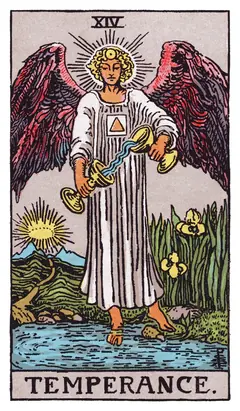
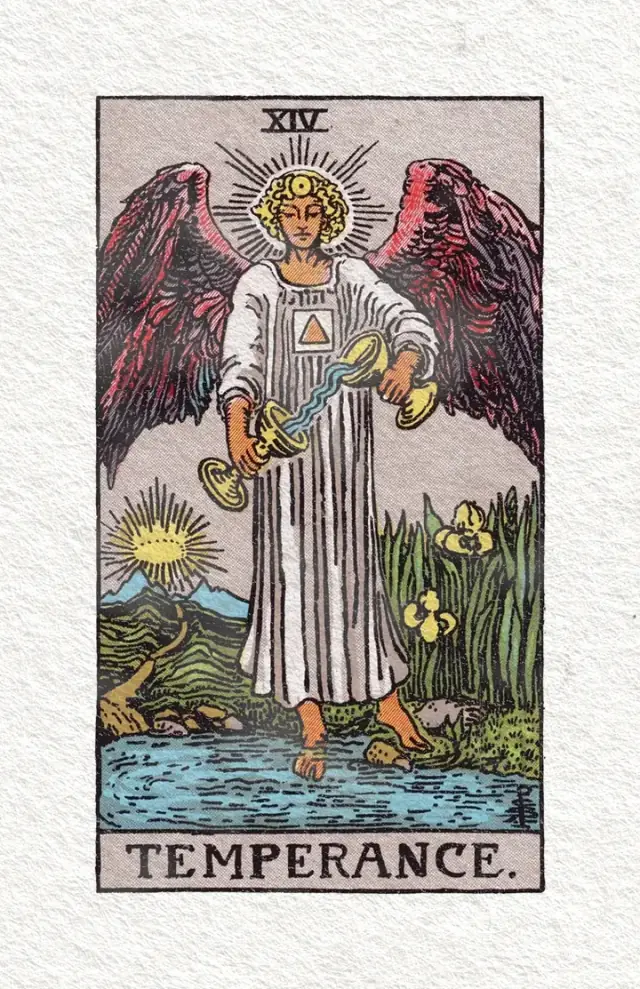
Temperance, pouring water between two cups, is a fair image for the method: the meaning is in what moves between the cards.
What if a card makes no sense?
Leave it for a moment and read the other two; the context often explains it. If it is still unclear, draw one more card as a for that position only. Do not redraw the whole spread: you will tend to keep the version you like. If a card jumps out of the deck while you shuffle, some readers treat this as part of the reading; others put it back.
Can you make your own three-card spread?
Yes, and most readers do. The rules are simple: each position asks one clear thing, the three positions do not overlap, and together they answer the question. A useful pattern is two cards that pull against each other and a third that resolves them, or a line of three steps in time. Write the positions on paper before you shuffle so they cannot drift while you read.
Three cards or the Celtic Cross?
Three cards suit most everyday questions and almost all learning. The Celtic Cross adds layers: what lies beneath the question, your hopes and fears, the people around you. Use it when a question deserves half an hour, and keep three cards for the rest. See How to read tarot.