Visconti-Sforza tarot
Decks · 3 min read · updated
The Visconti-Sforza tarot is the name for the hand-painted, gilded tarot cards made for the dukes of Milan in the mid-15th century, the oldest tarot cards that survive. About fifteen incomplete packs are known. The most famous, painted around 1450–1460 and attributed to the workshop of Bonifacio Bembo, is split between the Morgan Library in New York and two collections in Bergamo.
- Made
- Milan, c. 1440s–1460s
- Made for
- Filippo Maria Visconti and Francesco Sforza
- Painter
- Workshop of Bonifacio Bembo (attributed)
- Surviving packs
- Best-known pack
- 74 of 78 cards: New York and Bergamo
- Used for
What is the Visconti-Sforza tarot?
It is not one but a family of them. Filippo Maria Visconti, Duke of Milan until his death in 1447, and Francesco Sforza, who married Filippo's only daughter Bianca Maria in 1441 and became duke in 1450, ordered luxury packs of trionfi, the card game that later became tarot. Painters worked on pasteboard over a ground of tooled gold, and the cards show the courtly world of their owners: armour, brocade, horses, and the coats of arms and mottoes of both families.[1]
These were cards to play with, at court, not to read. Nobody is known to have used tarot for fortune-telling until three centuries later.[1] See Tarot as a card game and History of tarot.
The three famous packs
- Pierpont Morgan–Bergamo. The best known and the model for most modern reproductions. Originally 78 cards, now 74: 35 at the Morgan Library & Museum in New York, 26 at the Accademia Carrara in Bergamo and 13 in the Colleoni family collection, also in Bergamo.[2] When people say "the Visconti-Sforza tarot", they usually mean this pack.
- Cary-Yale. At Yale University since 1967, with 67 cards. It may be the oldest of all, from the 1440s, and it is the strangest: it has female as well as male knights and pages, and trumps not found in later tarot, the three theological virtues Faith, Hope and Charity.[1]
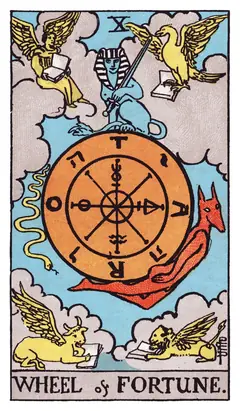
- Brera-Brambilla. At the Pinacoteca di Brera in Milan, 48 cards, almost all of them suit cards, with only two trumps left: the Emperor and the Wheel of Fortune.
Who painted the Visconti-Sforza tarot?
The Pierpont Morgan–Bergamo pack was long credited to Antonio Cicognara, a painter from Cremona. More recent research gives it instead to the workshop of Bonifacio Bembo, also of Cremona, who painted for the Sforza court from the 1440s to the 1470s.[1]
Six of the trumps are in a different, flatter style: Strength, Temperance, the Star, the Moon, the Sun and the World. They were painted by a second hand, either to replace lost cards or to finish the pack. Michael Dummett suggested Bonifacio's younger brother Benedetto.[1] Pin holes at the tops of some cards suggest the pack was lent to other painters as a model, and several partial copies of its designs survive.
Which cards are missing?
Four cards of the Pierpont Morgan–Bergamo pack are lost: the Devil, the Tower, the Three of Swords and the Knight of Coins.[1] Every modern edition that claims 78 cards has had these four drawn fresh in the old style. Whether a Devil and a Tower were ever painted for this pack is not certain; no Visconti-Sforza version of either card is known.
How is it different from a modern deck?
- No numbers or names. The trumps carry no titles and no numbers. Players knew the order by heart, and it varied between cities. The order most books use today comes from later printed decks.
- Plain numbered cards. The show only the emblems of their suit (coins, cups, batons or swords) set out on gold. Scenes on every card arrived with the Sola Busca in 1491 and became standard only with the Rider–Waite–Smith in 1909.
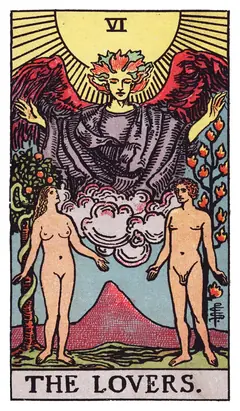
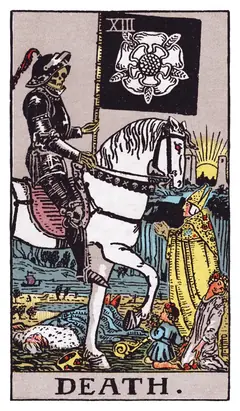
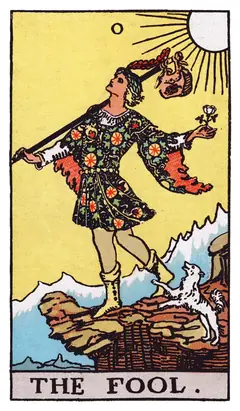
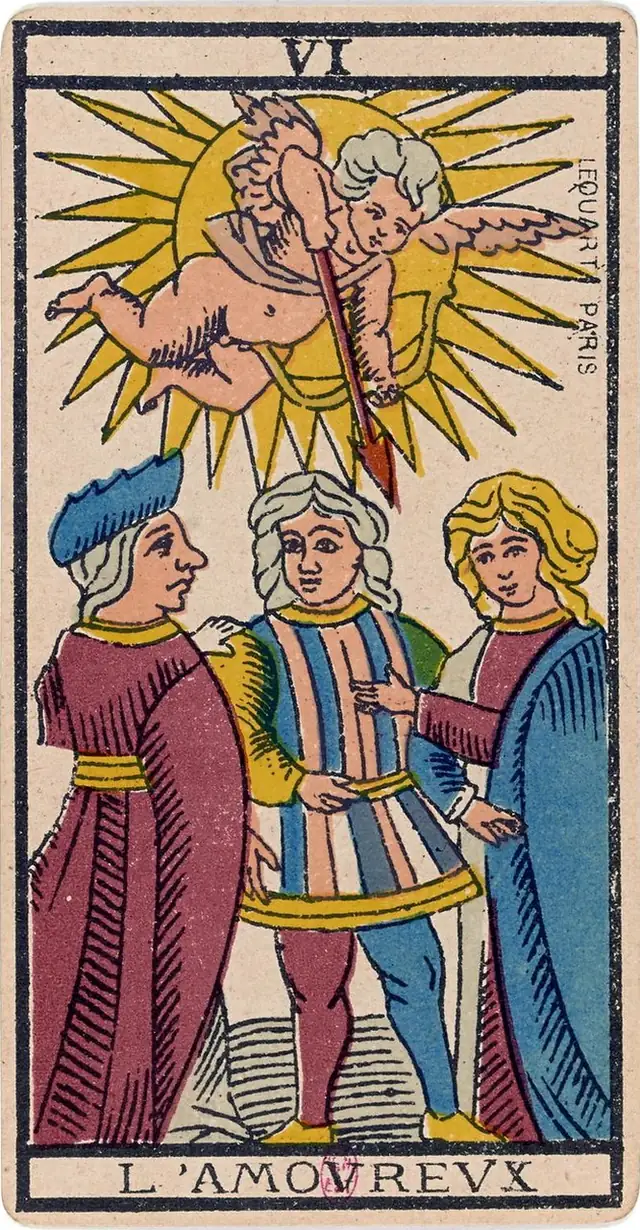
- Familiar faces. Many trumps are recognisable: a couple under a blindfolded Cupid for the Lovers, a skeleton with a bow for Death, a ragged man for the Fool. Some figures may be portraits of the family, though which, if any, is debated.
- Courts. Each suit has a King, Queen, Knight and Page, the four court ranks tarot still uses.
The later Tarot de Marseille keeps the same structure in woodcut, which is why its pictures feel like simplified cousins of these. See Rider–Waite–Smith vs Marseille.
Can you read with a Visconti-Sforza deck?
Yes, many readers do, using printed facsimiles of the Pierpont Morgan–Bergamo pack with the four missing cards supplied. It reads much like a Marseille deck: the trumps carry the meaning of their figures, and the numbered cards are read from their number and suit rather than from a scene. Because the trumps have no titles, it helps to know the well first. For a first deck most teachers suggest something with labelled cards; see How to choose a tarot deck.