How to learn tarot card meanings
Reading tarot · 4 min read · updated
The fastest way to learn tarot card meanings is not to memorise 78 separate lists but to learn the deck's structure. Four suits with one theme each, ten numbers with one step each and four court ranks give you the 56 Minor Arcana as a grid; the 22 Major Arcana tell one story in order. Add the pictures and a card a day, and most people can read any card in a few weeks.
- Cards to learn
- 78
- Actually to learn
- 4 suits, 10 numbers, 4 ranks, 22 trumps
- Time
- A few weeks for the basics
- Best daily habit
- Avoid
- Memorising keyword lists in order
- Deck to start with
- Rider–Waite–Smith or a deck based on it
Why memorising lists does not work
Lists are easy to learn and hard to use. A keyword such as 'abundance' tells you nothing about how the card relates to the one beside it, and when a card falls in an unexpected place, the list runs out. Readers who learned the structure can work a meaning out on the spot. That is the skill to build.
Step 1: learn the four suits
Each suit of the covers one area of life. Learn these four lines and you know something about 56 cards.
- : fire, drive, work, ambition, what you want to do.
- : water, feeling, love, friendship, what you feel.
- : air, thought, conflict, decisions, what you think.
- : earth, money, body, home, what you have.
See Tarot suits and Tarot and the elements.
Step 2: learn the numbers as steps
The Ace to Ten of each suit tell the same story: a beginning, a choice, growth, a pause, a setback, recovery, a test, movement, near-completion and the end of the cycle. Put a number with a suit and you have a first meaning: the Five is trouble, Cups is feeling, so the Five of Cups is a loss you are grieving. The picture then confirms or sharpens it. See Numbers in tarot.
Step 3: read the court cards as people
The 16 court cards are four ranks in four suits. Pages are learners and messages, Knights are action and movement, Queens are mastery turned inward, Kings mastery turned outward. A Queen of Swords is someone whose clear thinking serves themselves and those close to them; a King of Swords applies it to the world. Many readers find these the hardest cards, and thinking of real people you know helps.
Step 4: learn the Major Arcana as one story
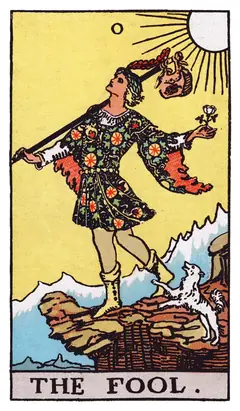
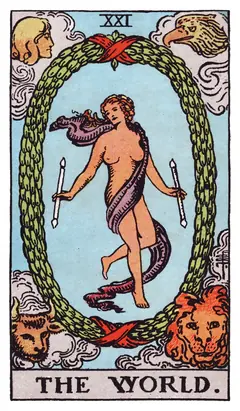
The 22 trumps are easier in order than one by one. Read them as a journey from the Fool setting out, through the teachers and powers of the first row, the trials of the middle, to the light of the last cards and the World. Each card then has a place, a before and an after. See The Fool's Journey and Major and Minor Arcana.
Step 5: look at the picture first
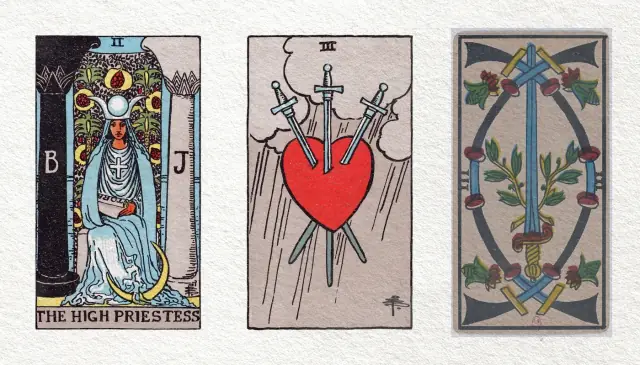
In the Rider–Waite–Smith and decks based on it, every card shows a scene. Before reaching for a meaning, describe what you see: who is there, what they are doing, the weather, the colours, which way they face. Most of the meaning is in the picture, and a description you made yourself is remembered far better than a keyword you were given. See Tarot symbols.
Step 6: one card a day, written down
- Each morning, draw one card.
- Write the card, what you see in it and one guess about the day.
- Only then check the card's usual meaning.
- In the evening, add one line on what actually happened.
Tying each card to a real day is the strongest memory aid there is. In a few months you will have met every card several times, each with a small story attached. See Daily tarot practice and Tarot journal.
Other tricks that help
- Compare the same number across suits. Lay out the four Fives, then the four Threes, and say what they share.
- Make your own keywords. Two or three words per card in your own language beat a borrowed list.
- Use flashcards sparingly. They help with names and numbers, not with reading.
- Leave reversals for later. Learn the upright cards first.
- Read for small questions. A three-card spread on a real question teaches more than reading about cards.
How long does it take?
With the structure above, most people can give a reasonable reading of any card within two to four weeks, and feel at home with the deck after a few months of daily practice. Nobody stops learning: experienced readers still find new things in cards they have seen a thousand times. See How to read tarot.